Part 2 in the Medicare for All House of Cards Series
“Every other developed country has universal healthcare.” It’s been said so many times that it’s almost cliché. Here’s the problem, universal healthcare doesn’t mean the same thing to everyone who says it and it comes in many forms even for the nations that have it. For our purposes, let’s call it “single-payer healthcare systems” so that we can build a clear picture of what we are trying to build. And let’s also make sure when we compare what happens in the US to what happens in other places, we make sure our comparisons take into account the scope and scale of what we are proposing.
Whenever single-payer healthcare is defended in American political discourse, proponents invariably point outside our borders, to Canada, the United Kingdom, or Western Europe, as proof that universal, government-run systems are efficient, affordable, and popular. This comparison is incomplete and perhaps even inappropriate.
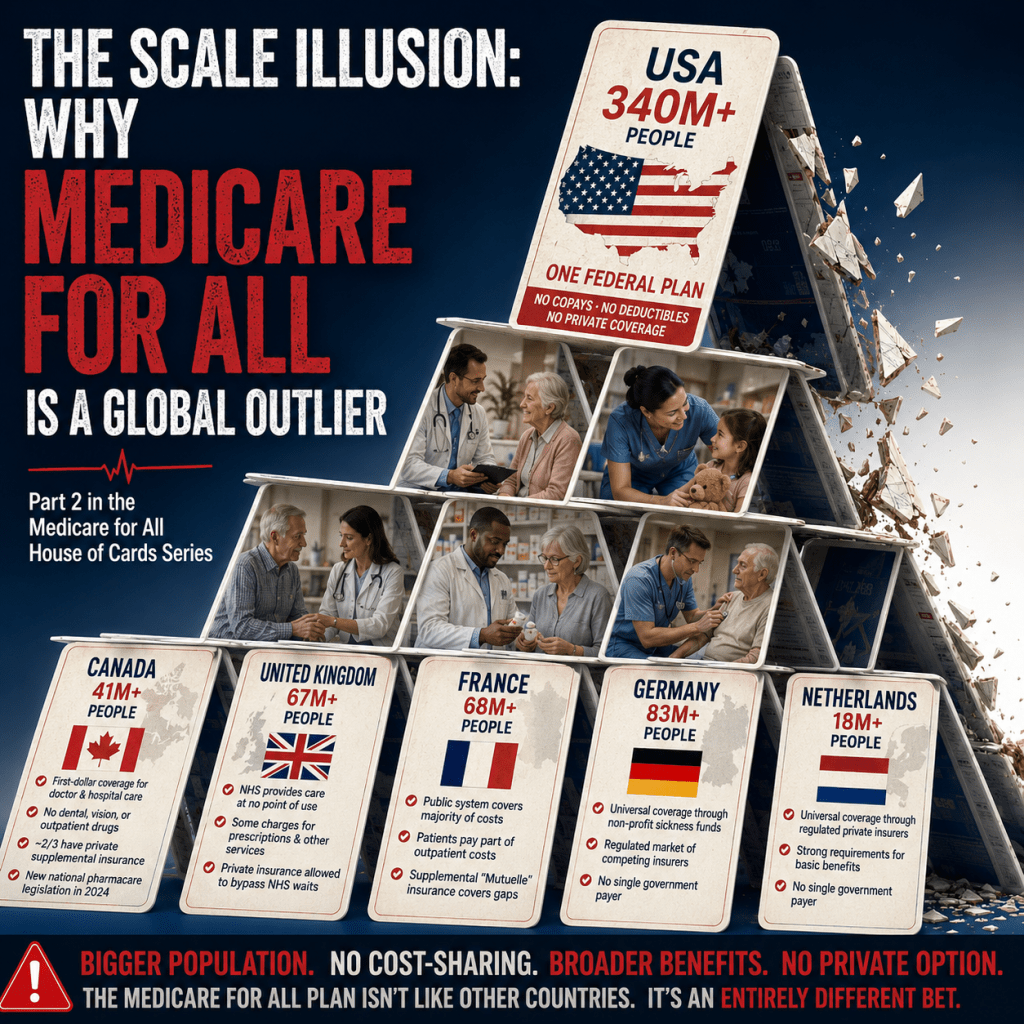
The single-payer system envisioned in the Medicare for All Act of 2025¹ is not a standard adoption of European-style socialized medicine. Despite arguments to the contrary, the US is not the same as those other nations often used for comparison. Examining the sheer scale and the specific design choices embedded in the American plan shows it departs from every existing universal system in the developed world in several important respects.
First: The US Context Demands an Unprecedented Leap in Scale
The most immediate difference between the proposed system and existing international models is scale. The United Kingdom’s National Health Service covers a population of roughly 67–68 million.² Canada’s Medicare system covers about 41 million people, and unlike the centralized U.S. proposal it is not run as a single national program; each of Canada’s provinces and territories administers its own plan under the framework of the federal Canada Health Act.³
The Medicare for All Act would consolidate a population of roughly 340 million people under a single federal program managed out of Washington.¹ A federal agency processing claims and setting national payment rates for over $3 trillion in annual spending across a population eight times the size of any comparable existing system represents a genuinely novel scale of administrative centralization. This is not necessarily unworkable, but it is untested at this scale.
Second: The Abolition of Cost-Sharing and Expanded Areas of Coverage Call for an Unprecedented Expansion of Scope
The current Medicare for All proposal calls for an elimination of nearly all point-of-service costs including copays, deductibles, and coinsurance, with only a $200 annual cap for prescription drugs.¹ This is unusual by international standards. According to the Commonwealth Fund’s International Health Care System Profiles, most peer nations retain some form of cost-sharing:
- Canada provides first-dollar coverage for physician and hospital services with no cost-sharing, but this doesn’t extend to dental care, vision care, or outpatient prescription drugs, which are excluded from the core public system in most provinces. About two-thirds of Canadians carry supplementary private insurance, commonly through employer plans, to cover these gaps. These supplemental plans would be outlawed under the Sanders plan in the US. Canada has historically been the only developed country with universal health coverage that doesn’t include a national pharmacare program, though the government introduced initial pharmacare legislation in 2024.³ ⁴
- France’s system reimburses a substantial share of routine outpatient costs through the public insurer, with patients typically responsible for the remainder, which most French residents cover through supplemental “Mutuelle” insurance, similar in spirit to Canada’s supplemental market.⁵
By eliminating essentially all of these gaps and cost-sharing mechanisms at once, the Sanders bill removes a tool that most peer systems still use, in some form, to manage utilization and cost.
Universal systems outside the US typically draw firmer lines around what the public system covers. As noted above, Canada’s core public program has historically excluded dental, vision, and outpatient drug coverage, pushing citizens toward private supplemental insurance or provincial safety-net programs for those services.³ ⁴ The Medicare for All Act, by contrast, folds comprehensive adult dental, vision, hearing, and long-term care directly into the core federal program at no cost to the patient¹ This is a substantially broader guaranteed benefit package than what any of these peer nations currently provides through their public system alone.
Perhaps the most restrictive element of the bill is its prohibition on private insurers selling coverage that duplicates the federal program’s benefits.¹ This is a genuine outlier internationally:
- Germany, France, and the Netherlands achieve universal coverage not through a single government payer but through tightly regulated markets of competing nonprofit or private “sickness funds” and insurers.⁵
- The UK’s NHS, despite being a pure single-payer system, does not prohibit private insurance. UK residents can purchase private medical insurance that runs in parallel to the NHS, allowing them to bypass NHS waiting lists for eligible treatment at private facilities, providing a safety valve the Sanders bill’s duplicate-coverage ban would eliminate.⁶
The Bottom Line
The Medicare for All Act is not a straightforward import of an existing European or Canadian model. It combines an unprecedented population scale, the near-total elimination of cost-sharing mechanisms that most peer systems still rely on, a broader core benefit package than any comparable country currently guarantees, and a ban on private competition stricter than what even single-payer Britain imposes. Whether that combination is a strength (a more genuinely universal system) or a liability (an untested set of simultaneous departures from every working model) is the crux of the policy debate — but it should be argued on those terms, rather than on the premise that the bill simply replicates what other countries already do successfully.
Sources
- Medicare for All Act, H.R. 3069, 119th Cong. (2025); S. 1506, 119th Cong. (2025). Full text: congress.gov/bill/119th-congress/house-bill/3069/text
- Office for National Statistics, UK population estimates; NHS England, “Overview of the NHS.” Commonwealth Fund International Health Care System Profiles — United Kingdom: commonwealthfund.org/international-health-policy-center/countries/united-kingdom
- Commonwealth Fund International Health Care System Profiles — Canada (2026 update): commonwealthfund.org/international-health-policy-center/countries/canada; PDF: commonwealthfund.org/sites/default/files/2026-04/2026_Country-Profiles_Canada.pdf
- Canadian Medical Association, “Who pays for Canadian health care?” cma.ca/healthcare-for-real/who-pays-canadian-health-care
- Commonwealth Fund International Health Care System Profiles — France, Germany, Netherlands: commonwealthfund.org/international-health-policy-center/system-profiles
- Commonwealth Fund International Health Care System Profiles — United Kingdom; general description of parallel NHS/private insurance structure consistent with the National Health Service Act 2006 framework.


