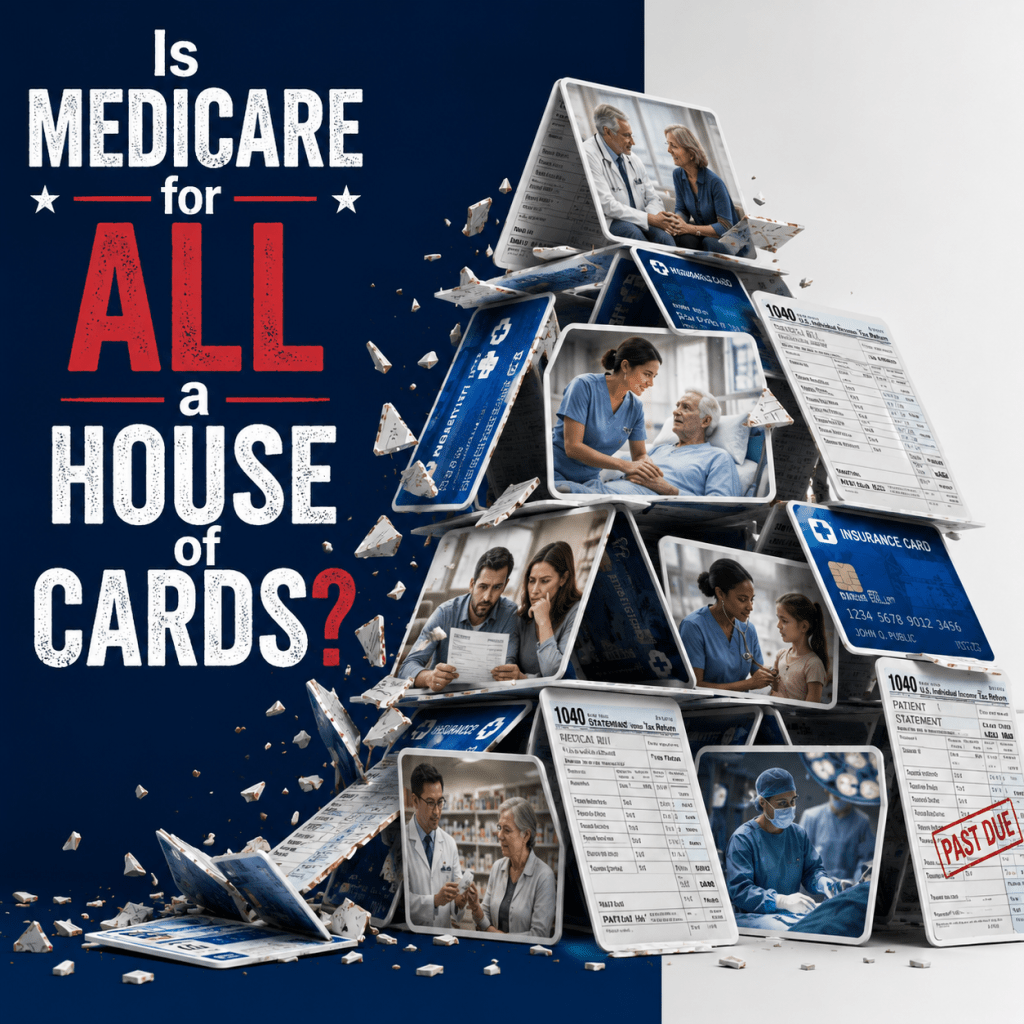
The American healthcare system is broken! That’s something a majority of Americans can agree on. How to fix it does not have such strong consensus. When it comes to fixing American healthcare, few proposals have generated as much passion, or as much fierce debate, as Senator Bernie Sanders’ Medicare for All.
On the surface, the promise is incredibly appealing: you walk into any hospital or doctor’s office, receive whatever care you need, and walk out without ever seeing a bill, a copay, or a deductible. No more fighting with insurance companies over claims. No more medical debt. Who wouldn’t want that?
But you can’t just legislate this into existence without considering the costs and the consequences. This is the first in a series of essays exploring those parts of the story. To understand if Medicare for All makes “good sense,” it is vital to look past the rhetoric and closely examine the math, the mechanics, and the monumental disruptions it would introduce to the American economy.
The first thing to understand is how Medicare for All is designed
The Sanders plan is a “single-payer” national health insurance program. This means the federal government completely replaces private commercial insurance and becomes the sole entity paying for medical care in the United States. Often called a “single payer” system, it is designed to consolidate the entire healthcare delivery system into a single administrative structure.
The structure relies on four core pillars:
- Universal Coverage: Every U.S. resident is automatically enrolled, with coverage beginning at birth or on establishing residency.
- Zero Out-of-Pocket Costs: All premiums, deductibles, and copays are eliminated for covered services, with prescription drugs the sole exception. (prescription drugs would have a small annual out of pocket max satisfied through co-pays)
- Comprehensive Benefits: The plan covers hospital care, mental health and substance abuse treatment, dental, vision, hearing, long-term care, and reproductive and gender-affirming care.
- A Ban on Duplicate Private Insurance: Private insurers and employers may only sell coverage that supplements the government program, not coverage that duplicates it. Note this one. It means the health insurance companies are out of business.
The current version of Medicare for All legislation suggests this system could be fully introduced over two years. ¹ Starting one year after enactment, children 18 and under, adults 55 and older, and those already on Medicare become eligible; by year two, coverage extends to everyone else. This sounds great, and many believe it is a substantial improvement over earlier versions that suggested it would take 4 years to implement. However, this faster on-ramp makes the cost analyses even more problematic.
Does this plan make Good Sense? Initial analysis reveals at least three critical concerns that could each be the “fatal flaw.”
1. The Trillion-Dollar Revenue Disparity
The most immediately glaring issue with Medicare for All is the math on the federal balance sheet. A 2019–2020 Urban Institute and Commonwealth Fund analysis put the federal cost of a comparable single-payer system at roughly $32 trillion over ten years; a separate 2018 study by Charles Blahous of the Mercatus Center put the figure at $32.6 trillion over the same period, using assumptions favorable to the plan’s proponents.² ³ Both studies modeled the bill’s earlier four-year phase-in. No independent group has re-run these models against the 2025 bill’s compressed two-year timeline. When those models are run it is likely that the overall costs will increase as larger numbers of American come on board earlier increasing utilization costs.
To pay for this, proponents, led by Senator Bernie Sanders, proposed a menu of progressive taxes, including a 4% individual income surcharge, a 7.5% employer payroll tax, and various wealth and corporate taxes. Independent analysts estimate that these combined taxes would likely fall well short of the $3.2–3.4 trillion in new annual spending, leaving a structural funding gap which could easily be in the hundreds of billions to over a trillion dollars per year, depending on which revenue and cost assumptions are used. Closing that gap would require either significantly higher taxes on all Americans, especially middle-class families, or a broad-based consumption tax. The argument that the increased costs are offset by savings across the healthcare system are considered in point number 3 below. Note, however, that the projected savings across the system do not equal the estimate 1 plus trillion-dollar annual budget deficits.
2. The Patient Influx vs. Shrinking Provider Pool
If you make a vital service completely free at the point of delivery, demand for that service will inevitably rise. Under the compressed two-year design, most of that demand surge, everyone not already covered in year one, arrives in a single additional year rather than spread across three. There are clear reasons to doubt that the system will have the capacity to meet that surge.
The supply of doctors, nurses, and hospital beds cannot scale overnight under any timeline. Because the plan aims to control costs by capping reimbursement rates near traditional Medicare levels, rates the Medicare Payment Advisory Commission (MedPAC) and multiple hospital associations have long noted run below private insurance rates, many hospitals could face revenue shortfalls that prompt closures or early physician retirements, shrinking the provider pool just as the compressed timeline asks it to absorb more patients, faster.
When a faster patient influx meets a static or shrinking pool of providers, the result is unavoidable: care rationing shifts from financial to temporal. Patients won’t be priced out of care, they’ll be timed out of it, facing longer waits for elective surgeries, specialist visits, and diagnostic imaging. The outcry today is that people are not getting necessary care because they can’t afford it. The likely outcome of the Medicare for All plan is that people will not get necessary care because they can’t get an appointment with a doctor, or they can’t get the test they need, or they can’t get a surgery scheduled.
The plan’s financial viability makes a huge and unsubstantiated assumption. It assumes up front that administrative costs will fall from the 12–15% typical of private insurers to the roughly 2% reported for traditional Medicare. The argument offers up substantial savings numbers for the system as a whole. For example, a December 2020 Congressional Budget Office working paper modeled several illustrative single-payer designs and found administrative savings ranging from $42 billion to $743 billion annually depending on assumptions. The most often cited savings number is $650 billion, but this comes from CBO’s most favorable “low payment rate, low cost-sharing” scenario, not a formal score of this bill.⁴ That analysis, like the Urban and Mercatus estimates, predates the 2025 bill’s faster rollout. In other words, these are highly optimistic numbers that are not supported by solid financial models. More detail on this problem will come in a later essay.
3. The Myth of Effortless Administrative Gains
Sources
Not only is the administrative gain open to dispute, dismantling the private insurance sector would displace a substantial share of the health insurance workforce. A 2018 economic analysis by researchers at the University of Massachusetts Amherst’s Political Economy Research Institute (PERI), a study broadly sympathetic to Medicare for All, estimated the number of displaced workers in insurance and related administrative roles at approximately 1.8 million, including nearly 300,000 workers aged 60 or older.⁵ What happens to those workers and those jobs?
While the plan proposes a federally funded Worker Transition Trust Fund to provide retraining and temporary wage replacement, history shows that government-run retraining programs struggle to efficiently transition displaced workers into comparable, high-paying careers. This is such an important part of this analysis it will get major focus in one of the later essays in this series.
The Bottom Line
Medicare for All sounds good. It plan attempts to pull off an unprecedented economic feat: covering 340 million people with the most generous benefits package in the developed world, outlawing market competition, and eliminating out-of-pocket costs — all while assuming administrative costs fall dramatically. The 2025 version raises the stakes further by compressing the rollout from four years to two, asking the tax base, the provider system, and the administrative machinery to adjust faster than any existing cost model has actually tested.
Good sense dictates that before we tear down the foundation of American healthcare on a tighter schedule than originally proposed, we should make sure the replacement blueprint isn’t a house of cards.
- Reintroduced in April 2025 alongside Reps. Pramila Jayapal and Debbie Dingell as S.1506 in the Senate and H.R.3069 in the House. Medicare for All Act, H.R. 3069, 119th Cong. (2025); S. 1506, 119th Cong. (2025). Full text: congress.gov/bill/119th-congress/house-bill/3069/text
- Urban Institute & Commonwealth Fund (2019). From Incremental to Comprehensive Health Insurance Reform. urban.org/research/publication/estimating-cost-single-payer-plan
- Blahous, C. (2018). The Costs of a National Single-Payer Healthcare System. Mercatus Center at George Mason University. mercatus.org — “How the Urban Institute’s Estimates of Medicare for All Costs Stack Up”
- Congressional Budget Office (December 2020). How CBO Analyzes the Costs of Proposals for Single-Payer Health Care Systems. cbo.gov/publication/56898
- Pollin, R., Heintz, J., Arno, P., Wicks-Lim, J., & Ash, M. (2018). Economic Analysis of Medicare for All. Political Economy Research Institute, University of Massachusetts Amherst, Appendix 6. peri.umass.edu/publication/economic-analysis-of-medicare-for-all
- Jayapal, P., quoted in “‘Medicare-for-all’ sponsor says plan would gut 1 million private insurance jobs,” Fox News (2019). foxnews.com/politics/medicare-for-all-would-gut-a-million-private-insurance-jobs

 Good Sense - A Discussion of Culture and Issues in America Today