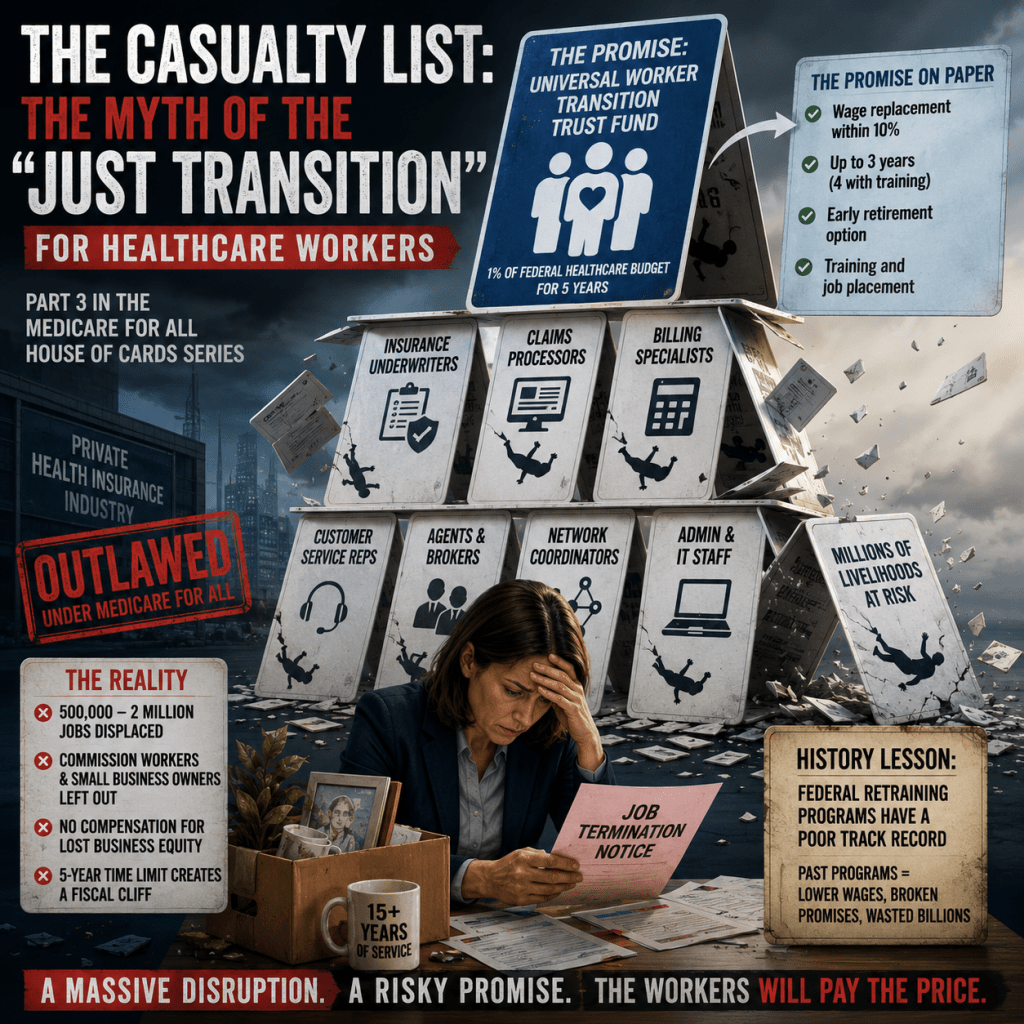
The Casualty List: The Myth of the “Just Transition” for Healthcare Workers

Part 3 in the Medicare for All House of Cards Series
Medicare for All sounds like a great solution to the problems in the US healthcare system, but when people talk about it they often do so without any recognition of the human cost of making this kind of structural change.  Implementing this plan would completely eliminate the health insurance industry and severely decrease opportunities for hundreds of thousands of Americans in businesses tied to that industry.  This cost must be added to the assessment of the overall plan.

The policy makers putting forth the Medicare for All plan are fully aware of the potential impact on the workforce.  When policymakers discuss these types of massive structural shifts, they frequently lean on a comforting euphemism: the “just transition.” In the Medicare for All Act of 2025 (S.1506/H.R.3069)¹, this concept takes the form of a federally funded worker transition program. Recognizing that a single-payer system would eliminate the private commercial health insurance market, the bill’s supporters promise to protect the livelihood of every displaced worker.

It is a noble promise, but it runs up against a significant logistical reality. A 2018 economic analysis by researchers at the Political Economy Research Institute (PERI) at UMass Amherst, a study conducted in support of Medicare for All, not against it, estimated that eliminating the private insurance and medical billing bureaucracy would displace approximately 1.8 million workers, including nearly 300,000 aged 60 or older.² A critical look at the funding mechanism and America’s historical record with federal job-retraining reveals real reasons for caution.

The Legislative Blueprint

The bill text provides for wage replacement, continued retirement and pension benefits, job training and placement, preferential hiring for displaced workers into new government roles, and education benefits.¹ Beyond that general framework, the precise formulas, how long wage support lasts, how it’s calculated for workers with variable income, and how tightly the transition period is bounded, are not fully specified in the bill text as introduced, leaving important implementation details to be worked out administratively.

This creates real ambiguity for certain groups. Independent insurance agents and brokers whose income relies on fluctuating commissions and policy renewals present a genuine complication: calculating a fair wage-replacement baseline for a self-employed contractor is more complex than for a salaried employee, and the bill does not appear to address the loss of a broker’s “book of business,” an active client portfolio that functions as a sellable asset, as a compensable loss.

The Structural Vulnerability of the Funding Model

Rep. Jayapal has publicly confirmed the funding mechanism: 1% of the total cost of the bill, set aside annually for five years, to support displaced workers.³ If, as estimates suggest, the single-payer budget runs $3–3.4 trillion annually, that translates to roughly $30–34 billion a year for worker transition.  This money comes out of the same overall health care budget, rather than from a separate, dedicated fund. That creates a structural tension: every dollar spent on severance, retraining, and placement services for displaced workers is a dollar not spent on direct patient care. And because the fund is bounded at five years, the program faces a hard cutoff if structural unemployment in this sector proves more persistent than anticipated.

The Historical Record: Why Federal Retraining Often Falls Short

Proponents argue that unprecedented funding levels will succeed where past programs failed. But America’s track record with federal job retraining gives real reason for skepticism. The clearest example is Trade Adjustment Assistance (TAA), the flagship federal program for retraining manufacturing workers displaced by trade. A rigorous 2012 evaluation conducted by Mathematica Policy Research for the U.S. Department of Labor, using a matched comparison group of similar displaced workers who did not participate in TAA, found that TAA participants earned about $3,300 less annually than their non-participating counterparts in the final year of the multi-year follow-up period, and calculated the program’s overall net benefit to society as negative.⁴ The researchers noted this may partly reflect the time it takes older, long-tenured workers to successfully retrain, a dynamic that could plausibly recur among displaced insurance-industry workers, many of whom are older, specialized administrative staff. Coal-to-clean-energy retraining programs offer a second cautionary parallel: these initiatives have consistently struggled with geographic and skill mismatches between displaced workers and available new jobs.

The Bottom Line

The Worker Transition program relies on succeeding where comparable federal efforts have historically struggled. Generous funding can pay for training and temporary income support, but it cannot guarantee that hundreds of thousands of specialized insurance and billing workers will find comparable new roles on the timeline the bill anticipates. The gap between the money committed and the outcomes historically achieved by similar programs is worth taking seriously before assuming this transition will go smoothly.

Let’s be clear, the problem with the Sanders plan isn’t a lack of funding for workers; it is a fundamental misunderstanding of labor logistics. Throwing $150 billion at a problem can buy tuition and extend unemployment checks, but it cannot instantly manufacture hundreds of thousands of vacant, high-paying, white-collar jobs that perfectly match the skills of displaced corporate insurance workers. Shifting an entire workforce by government decree is an incredibly slow, friction-heavy process. By limiting the trust fund to a strict five-year window, the plan assumes an economic agility that the federal government has never historically been able to deliver.


Sources

  1. Medicare for All Act, H.R. 3069, 119th Cong. (2025); S. 1506, 119th Cong. (2025). Full text: congress.gov/bill/119th-congress/house-bill/3069/text
  2. Pollin, R., Heintz, J., Arno, P., Wicks-Lim, J., & Ash, M. (2018). Economic Analysis of Medicare for All. Political Economy Research Institute, University of Massachusetts Amherst, Appendix 6: “Estimating Displaced Workers.” peri.umass.edu/publication/economic-analysis-of-medicare-for-all
  3. Jayapal, P., quoted in “‘Medicare-for-all’ sponsor says plan would gut 1 million private insurance jobs,” Fox News (2019). foxnews.com/politics/medicare-for-all-would-gut-a-million-private-insurance-jobs
  4. Schochet, P.Z., D’Amico, R., Berk, J., Dolfin, S., & Wozny, N. (2012). Estimated Impacts for Participants in the Trade Adjustment Assistance (TAA) Program Under the 2002 Amendments. Mathematica Policy Research, prepared for the U.S. Department of Labor. dol.gov/sites/dolgov/files/ETA/publications/ETAOP_2013_08.pdf

For Further Reading: Sources for the “House of Cards” Medicare for All Series

This document consolidates every source used to verify claims across all three essays in the Medicare for All series, plus additional context readers may find useful. Organized by topic.

The Bill Itself

Federal Cost Estimates

  • Blahous, C. (2018). The Costs of a National Single-Payer Healthcare System. Mercatus Center at George Mason University. Estimated ~$32.6 trillion in added federal costs over 10 years (2022–31), using assumptions favorable to the plan’s proponents as a lower-bound estimate. mercatus.org — “How the Urban Institute’s Estimates of Medicare for All Costs Stack Up”
  • Urban Institute & Commonwealth Fund (2019). From Incremental to Comprehensive Health Insurance Reform. Estimated ~$32–34 trillion in added federal costs over 10 years (2020–29). urban.org/research/publication/estimating-cost-single-payer-plan
  • Congressional Budget Office (December 2020). How CBO Analyzes the Costs of Proposals for Single-Payer Health Care Systems. Modeled four illustrative single-payer designs; savings ranged from $42 billion to $743 billion in 2030 depending on assumptions, with the closest match to current bills (“Option 3”) yielding roughly $650 billion in savings — the source of the frequently cited “$650 billion” figure. Note: this is an analysis of illustrative design options, not a formal score of H.R. 3069/S. 1506. cbo.gov/publication/56898
  • Pollin, R., Heintz, J., Arno, P., Wicks-Lim, J., & Ash, M. (2018). Economic Analysis of Medicare for All. Political Economy Research Institute (PERI), UMass Amherst. A study conducted in support of the 2017 Sanders bill; estimated net national health spending would fall by about 9.6% under the plan. peri.umass.edu/publication/economic-analysis-of-medicare-for-all
  • Yale School of Public Health study (Galvani et al., 2020), published in The Lancet — estimated Medicare for All could save approximately 68,000 lives and reduce health spending by roughly 13% (~$450 billion) annually. Referenced in: Public Citizen, “Fact Check: Medicare for All Would Save the U.S. Trillions”

Worker Displacement and Transition

  • PERI (2018), Appendix 6: “Estimating Displaced Workers” — estimated approximately 1.8 million workers displaced from private health insurance and related administrative roles, including nearly 300,000 aged 60 or older. Same source as above.
  • Jayapal, P. — public statement confirming the “1% of total bill cost, set aside annually for five years” worker transition funding mechanism, and a separate public estimate of “about a million” displaced workers. Reported in: Fox News, “‘Medicare-for-all’ sponsor says plan would gut 1 million private insurance jobs” (2019)
  • Schochet, P.Z., D’Amico, R., Berk, J., Dolfin, S., & Wozny, N. (2012). Estimated Impacts for Participants in the Trade Adjustment Assistance (TAA) Program Under the 2002 Amendments. Mathematica Policy Research, prepared for the U.S. Department of Labor. Found TAA participants earned about $3,300 less annually than a matched comparison group in the final follow-up year; overall net benefit to society calculated as negative. dol.gov/sites/dolgov/files/ETA/publications/ETAOP_2013_08.pdf
  • U.S. Department of Labor, “National Evaluation of the Trade Adjustment Assistance Program” — background on TAA program design and participation rates. dol.gov/agencies/eta/research/publications/national-evaluation-trade-adjustment-assistance-program

International Comparisons

Independent Fact-Checking and Context

The Scale Illusion: “Medicare for All” Is a Global Outlier

Part 2 in the Medicare for All House of Cards Series

“Every other developed country has universal healthcare.”  It’s been said so many times that it’s almost cliché.  Here’s the problem, universal healthcare doesn’t mean the same thing to everyone who says it and it comes in many forms even for the nations that have it.  For our purposes, let’s call it “single-payer healthcare systems” so that we can build a clear picture of what we are trying to build.  And let’s also make sure when we compare what happens in the US to what happens in other places, we make sure our comparisons take into account the scope and scale of what we are proposing.

Whenever single-payer healthcare is defended in American political discourse, proponents invariably point outside our borders, to Canada, the United Kingdom, or Western Europe, as proof that universal, government-run systems are efficient, affordable, and popular. This comparison is incomplete and perhaps even inappropriate.

The single-payer system envisioned in the Medicare for All Act of 2025¹ is not a standard adoption of European-style socialized medicine. Despite arguments to the contrary, the US is not the same as those other nations often used for comparison. Examining the sheer scale and the specific design choices embedded in the American plan shows it departs from every existing universal system in the developed world in several important respects.

First: The US Context Demands an Unprecedented Leap in Scale

The most immediate difference between the proposed system and existing international models is scale. The United Kingdom’s National Health Service covers a population of roughly 67–68 million.² Canada’s Medicare system covers about 41 million people, and unlike the centralized U.S. proposal it is not run as a single national program; each of Canada’s provinces and territories administers its own plan under the framework of the federal Canada Health Act.³

The Medicare for All Act would consolidate a population of roughly 340 million people under a single federal program managed out of Washington.¹ A federal agency processing claims and setting national payment rates for over $3 trillion in annual spending across a population eight times the size of any comparable existing system represents a genuinely novel scale of administrative centralization.  This is not necessarily unworkable, but it is untested at this scale.

Second: The Abolition of Cost-Sharing and Expanded Areas of Coverage Call for an Unprecedented Expansion of Scope

The current Medicare for All proposal calls for an elimination of nearly all point-of-service costs including copays, deductibles, and coinsurance, with only a $200 annual cap for prescription drugs.¹  This is unusual by international standards. According to the Commonwealth Fund’s International Health Care System Profiles, most peer nations retain some form of cost-sharing:

  • Canada provides first-dollar coverage for physician and hospital services with no cost-sharing, but this doesn’t extend to dental care, vision care, or outpatient prescription drugs, which are excluded from the core public system in most provinces. About two-thirds of Canadians carry supplementary private insurance, commonly through employer plans, to cover these gaps. These supplemental plans would be outlawed under the Sanders plan in the US.  Canada has historically been the only developed country with universal health coverage that doesn’t include a national pharmacare program, though the government introduced initial pharmacare legislation in 2024.³ ⁴
  • France’s system reimburses a substantial share of routine outpatient costs through the public insurer, with patients typically responsible for the remainder, which most French residents cover through supplemental “Mutuelle” insurance, similar in spirit to Canada’s supplemental market.⁵

By eliminating essentially all of these gaps and cost-sharing mechanisms at once, the Sanders bill removes a tool that most peer systems still use, in some form, to manage utilization and cost.

Universal systems outside the US typically draw firmer lines around what the public system covers. As noted above, Canada’s core public program has historically excluded dental, vision, and outpatient drug coverage, pushing citizens toward private supplemental insurance or provincial safety-net programs for those services.³ ⁴ The Medicare for All Act, by contrast, folds comprehensive adult dental, vision, hearing, and long-term care directly into the core federal program at no cost to the patient¹  This is a substantially broader guaranteed benefit package than what any of these peer nations currently provides through their public system alone.

Perhaps the most restrictive element of the bill is its prohibition on private insurers selling coverage that duplicates the federal program’s benefits.¹ This is a genuine outlier internationally:

  • Germany, France, and the Netherlands achieve universal coverage not through a single government payer but through tightly regulated markets of competing nonprofit or private “sickness funds” and insurers.⁵
  • The UK’s NHS, despite being a pure single-payer system, does not prohibit private insurance. UK residents can purchase private medical insurance that runs in parallel to the NHS, allowing them to bypass NHS waiting lists for eligible treatment at private facilities,  providing a safety valve the Sanders bill’s duplicate-coverage ban would eliminate.⁶

The Bottom Line

The Medicare for All Act is not a straightforward import of an existing European or Canadian model. It combines an unprecedented population scale, the near-total elimination of cost-sharing mechanisms that most peer systems still rely on, a broader core benefit package than any comparable country currently guarantees, and a ban on private competition stricter than what even single-payer Britain imposes. Whether that combination is a strength (a more genuinely universal system) or a liability (an untested set of simultaneous departures from every working model) is the crux of the policy debate — but it should be argued on those terms, rather than on the premise that the bill simply replicates what other countries already do successfully.


Sources

  1. Medicare for All Act, H.R. 3069, 119th Cong. (2025); S. 1506, 119th Cong. (2025). Full text: congress.gov/bill/119th-congress/house-bill/3069/text
  2. Office for National Statistics, UK population estimates; NHS England, “Overview of the NHS.” Commonwealth Fund International Health Care System Profiles — United Kingdom: commonwealthfund.org/international-health-policy-center/countries/united-kingdom
  3. Commonwealth Fund International Health Care System Profiles — Canada (2026 update): commonwealthfund.org/international-health-policy-center/countries/canada; PDF: commonwealthfund.org/sites/default/files/2026-04/2026_Country-Profiles_Canada.pdf
  4. Canadian Medical Association, “Who pays for Canadian health care?” cma.ca/healthcare-for-real/who-pays-canadian-health-care
  5. Commonwealth Fund International Health Care System Profiles — France, Germany, Netherlands: commonwealthfund.org/international-health-policy-center/system-profiles
  6. Commonwealth Fund International Health Care System Profiles — United Kingdom; general description of parallel NHS/private insurance structure consistent with the National Health Service Act 2006 framework.

Medicare for All: A Bold Promise or a House of Cards?

The American healthcare system is broken!  That’s something a majority of Americans can agree on.  How to fix it does not have such strong consensus.  When it comes to fixing American healthcare, few proposals have generated as much passion, or as much fierce debate, as Senator Bernie Sanders’ Medicare for All. 

On the surface, the promise is incredibly appealing: you walk into any hospital or doctor’s office, receive whatever care you need, and walk out without ever seeing a bill, a copay, or a deductible. No more fighting with insurance companies over claims. No more medical debt. Who wouldn’t want that? 

But you can’t just legislate this into existence without considering the costs and the consequences.  This is the first in a series of essays exploring those parts of the story. To understand if Medicare for All makes “good sense,” it is vital to look past the rhetoric and closely examine the math, the mechanics, and the monumental disruptions it would introduce to the American economy.

The first thing to understand is how Medicare for All is designed

The Sanders plan is a “single-payer” national health insurance program. This means the federal government completely replaces private commercial insurance and becomes the sole entity paying for medical care in the United States.  Often called a “single payer” system, it is designed to consolidate the entire healthcare delivery system into a single administrative structure.

The structure relies on four core pillars:

  • Universal Coverage: Every U.S. resident is automatically enrolled, with coverage beginning at birth or on establishing residency.
  • Zero Out-of-Pocket Costs: All premiums, deductibles, and copays are eliminated for covered services, with prescription drugs the sole exception. (prescription drugs would have a small annual out of pocket max satisfied through co-pays)
  • Comprehensive Benefits: The plan covers hospital care, mental health and substance abuse treatment, dental, vision, hearing, long-term care, and reproductive and gender-affirming care.
  • A Ban on Duplicate Private Insurance: Private insurers and employers may only sell coverage that supplements the government program, not coverage that duplicates it.  Note this one.  It means the health insurance companies are out of business.

The current version of Medicare for All legislation suggests this system could be fully introduced over two years. ¹ Starting one year after enactment, children 18 and under, adults 55 and older, and those already on Medicare become eligible; by year two, coverage extends to everyone else.  This sounds great, and many believe it is a substantial improvement over earlier versions that suggested it would take 4 years to implement.  However, this faster on-ramp makes the cost analyses even more problematic.

Does this plan make Good Sense?  Initial analysis reveals at least three critical concerns that could each be the “fatal flaw.”

1. The Trillion-Dollar Revenue Disparity

The most immediately glaring issue with Medicare for All is the math on the federal balance sheet. A 2019–2020 Urban Institute and Commonwealth Fund analysis put the federal cost of a comparable single-payer system at roughly $32 trillion over ten years; a separate 2018 study by Charles Blahous of the Mercatus Center put the figure at $32.6 trillion over the same period, using assumptions favorable to the plan’s proponents.² ³ Both studies modeled the bill’s earlier four-year phase-in.  No independent group has re-run these models against the 2025 bill’s compressed two-year timeline.  When those models are run it is likely that the overall costs will increase as larger numbers of American come on board earlier increasing utilization costs.

To pay for this, proponents, led by Senator Bernie Sanders, proposed a menu of progressive taxes, including a 4% individual income surcharge, a 7.5% employer payroll tax, and various wealth and corporate taxes. Independent analysts estimate that these combined taxes would likely fall well short of the $3.2–3.4 trillion in new annual spending, leaving a structural funding gap which could easily be in the hundreds of billions to over a trillion dollars per year, depending on which revenue and cost assumptions are used. Closing that gap would require either significantly higher taxes on all Americans, especially middle-class families, or a broad-based consumption tax.  The argument that the increased costs are offset by savings across the healthcare system are considered in point number 3 below. Note, however, that the projected savings across the system do not equal the estimate 1 plus trillion-dollar annual budget deficits.

2. The Patient Influx vs. Shrinking Provider Pool

If you make a vital service completely free at the point of delivery, demand for that service will inevitably rise. Under the compressed two-year design, most of that demand surge, everyone not already covered in year one, arrives in a single additional year rather than spread across three.  There are clear reasons to doubt that the system will have the capacity to meet that surge.

The supply of doctors, nurses, and hospital beds cannot scale overnight under any timeline. Because the plan aims to control costs by capping reimbursement rates near traditional Medicare levels, rates the Medicare Payment Advisory Commission (MedPAC) and multiple hospital associations have long noted run below private insurance rates, many hospitals could face revenue shortfalls that prompt closures or early physician retirements, shrinking the provider pool just as the compressed timeline asks it to absorb more patients, faster.

When a faster patient influx meets a static or shrinking pool of providers, the result is unavoidable: care rationing shifts from financial to temporal. Patients won’t be priced out of care, they’ll be timed out of it, facing longer waits for elective surgeries, specialist visits, and diagnostic imaging.  The outcry today is that people are not getting necessary care because they can’t afford it.  The likely outcome of the Medicare for All plan is that people will not get necessary care because they can’t get an appointment with a doctor, or they can’t get the test they need, or they can’t get a surgery scheduled.

The plan’s financial viability makes a huge and unsubstantiated assumption.  It assumes up front that administrative costs will fall from the 12–15% typical of private insurers to the roughly 2% reported for traditional Medicare.  The argument offers up substantial savings numbers for the system as a whole. For example, a December 2020 Congressional Budget Office working paper modeled several illustrative single-payer designs and found administrative savings ranging from $42 billion to $743 billion annually depending on assumptions.  The most often cited savings number is $650 billion, but this comes from CBO’s most favorable “low payment rate, low cost-sharing” scenario, not a formal score of this bill.⁴ That analysis, like the Urban and Mercatus estimates, predates the 2025 bill’s faster rollout.  In other words, these are highly optimistic numbers that are not supported by solid financial models.  More detail on this problem will come in a later essay.

3. The Myth of Effortless Administrative Gains

Sources

Not only is the administrative gain open to dispute, dismantling the private insurance sector would displace a substantial share of the health insurance workforce. A 2018 economic analysis by researchers at the University of Massachusetts Amherst’s Political Economy Research Institute (PERI), a study broadly sympathetic to Medicare for All, estimated the number of displaced workers in insurance and related administrative roles at approximately 1.8 million, including nearly 300,000 workers aged 60 or older.⁵ What happens to those workers and those jobs?

While the plan proposes a federally funded Worker Transition Trust Fund to provide retraining and temporary wage replacement, history shows that government-run retraining programs struggle to efficiently transition displaced workers into comparable, high-paying careers.  This is such an important part of this analysis it will get major focus in one of the later essays in this series.

The Bottom Line

Medicare for All sounds good.  It plan attempts to pull off an unprecedented economic feat: covering 340 million people with the most generous benefits package in the developed world, outlawing market competition, and eliminating out-of-pocket costs — all while assuming administrative costs fall dramatically. The 2025 version raises the stakes further by compressing the rollout from four years to two, asking the tax base, the provider system, and the administrative machinery to adjust faster than any existing cost model has actually tested.

Good sense dictates that before we tear down the foundation of American healthcare on a tighter schedule than originally proposed, we should make sure the replacement blueprint isn’t a house of cards.


  1. Reintroduced in April 2025 alongside Reps. Pramila Jayapal and Debbie Dingell as S.1506 in the Senate and H.R.3069 in the House.  Medicare for All Act, H.R. 3069, 119th Cong. (2025); S. 1506, 119th Cong. (2025). Full text: congress.gov/bill/119th-congress/house-bill/3069/text
  1. Urban Institute & Commonwealth Fund (2019). From Incremental to Comprehensive Health Insurance Reform. urban.org/research/publication/estimating-cost-single-payer-plan
  2. Blahous, C. (2018). The Costs of a National Single-Payer Healthcare System. Mercatus Center at George Mason University. mercatus.org — “How the Urban Institute’s Estimates of Medicare for All Costs Stack Up”
  3. Congressional Budget Office (December 2020). How CBO Analyzes the Costs of Proposals for Single-Payer Health Care Systems. cbo.gov/publication/56898
  4. Pollin, R., Heintz, J., Arno, P., Wicks-Lim, J., & Ash, M. (2018). Economic Analysis of Medicare for All. Political Economy Research Institute, University of Massachusetts Amherst, Appendix 6. peri.umass.edu/publication/economic-analysis-of-medicare-for-all
  5. Jayapal, P., quoted in “‘Medicare-for-all’ sponsor says plan would gut 1 million private insurance jobs,” Fox News (2019). foxnews.com/politics/medicare-for-all-would-gut-a-million-private-insurance-jobs

Navigating the Post-Truth Era: Balancing Facts and Feelings

Over the past century, Western societies have increasingly expanded the authority granted to subjective experience in defining personal identity and public life. This development has brought new insights into human experience while also creating difficult questions about how subjective experience should relate to empirical evidence, shared institutions, and democratic decision-making.

This may describe one of the most significant cultural changes of the modern era. For most of Western history, truth was understood to exist outside ourselves. Whether grounded in God, nature, science, law, or long-established institutions, truth was assumed to be something that individuals discovered rather than created. Personal experience certainly mattered, but it was generally viewed as one source of knowledge among many. Experience could illuminate reality, but it did not define reality.

Over the last century, that balance has gradually shifted. Our culture has increasingly elevated subjective experience from being evidence about the world to becoming an authority over the world. The question has subtly changed from “What is true?” to “What is true for me?” This shift has produced genuine benefits. It has encouraged greater attention to mental health, increased awareness of trauma, and given voice to people whose experiences were too often dismissed or ignored. It has reminded us that statistics do not tell every human story and that empathy requires listening before judging. But every cultural gain comes with its own set of challenges.

When personal experience becomes the highest authority, disagreement becomes increasingly difficult. If my deepest feelings define reality, then questioning my conclusions can feel like questioning my identity. Debate no longer concerns competing interpretations of evidence; it becomes a conflict between competing personal realities. This helps explain why contemporary public discourse often feels so different from previous generations.

Political debates rarely stay focused on evidence for long. Scientific findings are frequently filtered through ideological commitments before they are evaluated. Social media algorithms reward emotional certainty over careful reasoning. Public conversations increasingly ask us not merely to disagree with one another but to choose which competing narratives we will inhabit. In this environment, facts often become secondary to identity. Psychologist Jonathan Haidt argues that “Intuitions come first, strategic reasoning second.” We often believe we are reasoning our way to conclusions when we are actually defending conclusions our emotions have already reached.

The modern phrase “my truth” captures this transformation perfectly. It usually does not mean “my perspective” or “my experience.” It often suggests that personal experience possesses its own independent authority regardless of whether it corresponds with external reality.

This is one reason the phrase “post-truth” has become so common. A post-truth society is not necessarily one in which facts disappear. Rather, it is one in which facts lose their ability to settle disagreements because different groups no longer recognize the same standards of authority. Hannah Arendt warned more than fifty years ago that “Freedom of opinion is a farce unless factual information is guaranteed.” Democracy depends on vigorous debate, but debate becomes impossible if citizens no longer share a common understanding of basic facts.

“Freedom of opinion is a farce unless factual information is guaranteed.”
— Hannah Arendt, Truth and Politics (1967)

History offers an interesting parallel. During the Modernist-Fundamentalist conflict of the early twentieth century, Christians fiercely debated the authority of Scripture, science, historical criticism, and religious experience. Both sides appealed to sources outside themselves—even when they disagreed profoundly about which sources deserved the greatest authority. The central question was, “What should count as authoritative?”

Today’s cultural conflicts often ask a different question altogether. Increasingly, authority itself is being relocated into the individual. Personal authenticity has become the highest moral value. To deny someone’s internal understanding of themselves is frequently seen not merely as disagreement but as harm. This development can be seen in debates over gender identity, politics, race, religion, and countless other issues. These debates are not simply disagreements about policy. They reflect competing understandings of where truth ultimately resides. Competing world views that are increasingly incompatible.

One worldview continues to believe that reality exists independently of us and that our responsibility is to discover and understand it as honestly as possible. The other increasingly argues that our internal experience plays a central role in defining who we are and how society should recognize us. Neither position is entirely wrong, but the conflict between them makes it ever more difficult to reconcile the two.

Objective facts without compassion can become cold and dehumanizing. Human beings are more than data points, and every statistic represents real lives with real experiences. Yet subjective experience without objective reference points creates its own dangers. If every deeply held conviction becomes equally authoritative, society loses the shared standards necessary for resolving disagreements peacefully. Democracy depends upon citizens who can disagree while still appealing to common evidence, common language, and common institutions. That may be the greatest challenge facing contemporary culture. 

The real danger of the post-truth age is not that people tell more lies than previous generations. Human beings have always distorted the truth when it served their interests. The deeper danger is that we increasingly lack agreement about what counts as truth in the first place. Once that happens, every disagreement becomes a struggle for power rather than a search for understanding.

Everyone is entitled to his own opinion, but not to his own facts.

Daniel Patrick Moynihan

Perhaps recovering healthy public discourse does not require choosing between objective facts and subjective experience. We need both. Human experience often raises important questions that demand our attention. Empirical evidence helps us test our conclusions. Compassion reminds us why the discussion matters. Humility reminds us that none of us sees the whole picture.

Truth has always required both careful observation and honest self-examination. The challenge before our generation is not deciding whether feelings matter. They do. The challenge is remembering that feelings, however deeply felt, are not the same thing as facts. A healthy society requires both empathy for individual experience and a shared commitment to realities that exist beyond ourselves. Only then can disagreement become what it ought to be—not a battle between competing identities, but a common search for what is true.

Selected References for Further Reading

Foundational Works on Truth, Identity, and Modern Culture

Arendt, Hannah. Between Past and Future: Eight Exercises in Political Thought. New York: Viking Press, 1961. (See especially the essay “Truth and Politics,” added in the 1968 edition.)

Bellah, Robert N., Richard Madsen, William M. Sullivan, Ann Swidler, and Steven M. Tipton. Habits of the Heart: Individualism and Commitment in American Life. Berkeley: University of California Press, 1985.

Berger, Peter L., Brigitte Berger, and Hansfried Kellner. The Homeless Mind: Modernization and Consciousness. New York: Random House, 1973.

Cassam, Quassim. Vices of the Mind: From the Intellectual to the Political. Oxford: Oxford University Press, 2019.

Haidt, Jonathan. The Coddling of the American Mind: How Good Intentions and Bad Ideas Are Setting Up a Generation for Failure. New York: Penguin Press, 2018.

Haidt, Jonathan. The Righteous Mind: Why Good People Are Divided by Politics and Religion. New York: Pantheon Books, 2012.

Higgins, Kathleen. “Post-Truth: A Guide for the Perplexed.” Nature, Vol. 540 (2016): 9.

Keyes, Ralph. The Post-Truth Era: Dishonesty and Deception in Contemporary Life. New York: St. Martin’s Press, 2004.

Lasch, Christopher. The Culture of Narcissism: American Life in an Age of Diminishing Expectations. New York: W. W. Norton & Company, 1979.

Levin, Yuval. A Time to Build: From Family and Community to Congress and the Campus, How Recommitting to Our Institutions Can Revive the American Dream. New York: Basic Books, 2020.

MacIntyre, Alasdair. After Virtue: A Study in Moral Theory. 3rd ed. Notre Dame, IN: University of Notre Dame Press, 2007.

McIntyre, Lee. Post-Truth. Cambridge, MA: MIT Press, 2018.

Moynihan, Daniel Patrick. Daniel Patrick Moynihan: A Portrait in Letters of an American Visionary. Edited by Steven R. Weisman. New York: PublicAffairs, 2010. (Contains the frequently quoted statement, “Everyone is entitled to his own opinion, but not to his own facts.”)

Postman, Neil. Amusing Ourselves to Death: Public Discourse in the Age of Show Business. New York: Penguin Books, 1985.

Rieff, Philip. The Triumph of the Therapeutic: Uses of Faith after Freud. Chicago: University of Chicago Press, 1966.

Taylor, Charles. A Secular Age. Cambridge, MA: Harvard University Press, 2007.

Taylor, Charles. Sources of the Self: The Making of the Modern Identity. Cambridge, MA: Harvard University Press, 1989.

Trueman, Carl R. The Rise and Triumph of the Modern Self: Cultural Amnesia, Expressive Individualism, and the Road to Sexual Revolution. Wheaton, IL: Crossway, 2020.

Weaver, Richard M. Ideas Have Consequences. Chicago: University of Chicago Press, 1948.

Historical Background on American Religion and Culture

Marsden, George M. Fundamentalism and American Culture. 2nd ed. New York: Oxford University Press, 2006.

Noll, Mark A. The Scandal of the Evangelical Mind. Grand Rapids, MI: Eerdmans, 1994.

Smith, Christian. What Is a Person? Rethinking Humanity, Social Life, and the Moral Good from the Person Up. Chicago: University of Chicago Press, 2010.

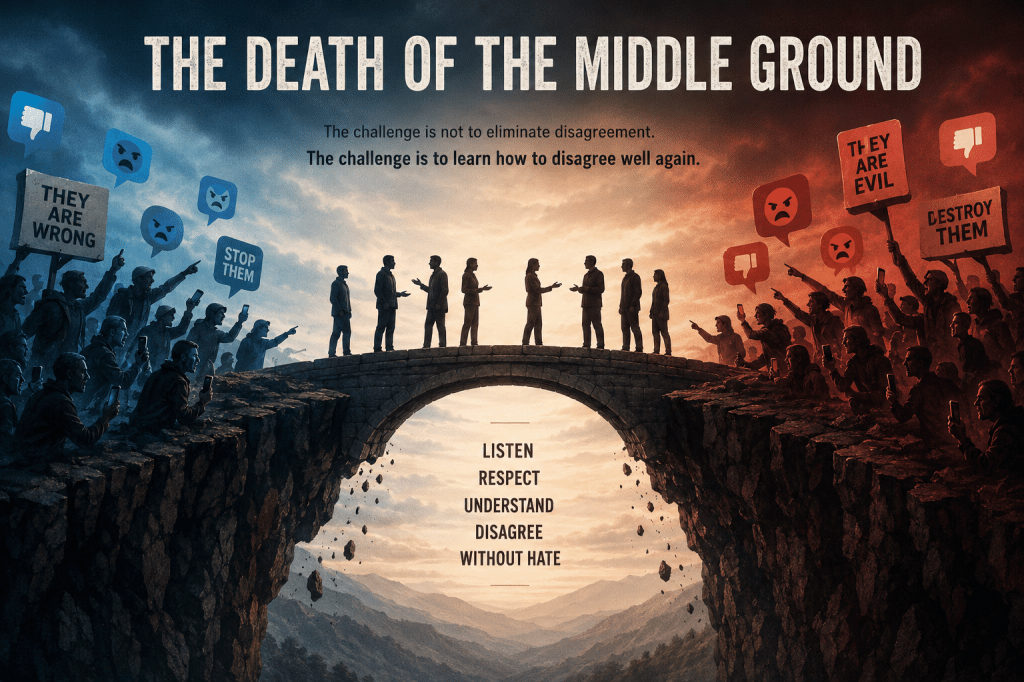
The Death of the Middle Ground

Spend ten minutes on social media and you’ll quickly discover that America is angry.

Conservatives are convinced progressives are destroying the country and that socialism is just around the corner. Progressives are convinced conservatives are destroying democracy and introducing Fascism to destroy our liberties. Every election is described as the most important in history. Every controversy becomes a moral emergency. Every disagreement is framed as a battle between good and evil.

If you spend enough time online, you might conclude that Americans have never been more divided. But I wonder if that’s really true.

America has always been a nation of disagreement. It only takes a brief look at our history to see that this is true. We have argued about religion, politics, economics, education, immigration, war, race, and countless other issues. Some of those disagreements have been intense enough to divide families, split churches, reshape political parties, and alter the course of the nation itself. Disagreement is not new in America.

In fact, disagreement has often been one of America’s greatest strengths. The founders disagreed. Religious leaders disagreed. Political parties disagreed. Citizens disagreed. The expectation was never that everyone would think alike. The expectation was that ideas would be tested through debate, persuasion, and experience and in the end, peace and tranquility would be maintained through compromise.

What is perhaps most troubling today is not that we disagree, but that we seem to be changing how we think about disagreement itself. Previous generations often viewed disagreement as a problem to be debated. Increasingly, we view disagreement as proof that the other person is morally defective. You’re not just wrong, you are evil.

For much of our history, Americans encountered disagreement within institutions that required ongoing relationships. We worshiped together. We served on civic committees together. We attended community meetings together. We worked together. We coached our children’s baseball teams together. The person whose politics irritated you was still your neighbor. The church member whose views frustrated you still sat beside you on Sunday morning. The coworker who saw the world differently was still someone you shared lunch with on Monday.

Those relationships mattered. They reminded us that human beings are more complicated than their opinions. They taught us that disagreement and respect could coexist. They forced us to recognize that intelligent, decent people sometimes arrive at very different conclusions. 

Today many of those institutions have weakened, and social media has increasingly become our public square. Unfortunately, social media was never designed to help us understand one another. It was designed to capture our attention. The more time we spend scrolling, commenting, sharing, and reacting, the more valuable we become to advertisers. And few things capture attention more effectively than outrage. We have outrage to spare in today’s social media environment. Influencers, activists, and organizers frequently wield righteous anger, fear, and indignation as powerful tools of persuasion.

Anger keeps us engaged. It makes us want to fight back. Fear keeps us watching, waiting for the next attack.  Indignation keeps us clicking, looking for the next sign of injustice. The algorithms have learned what sensationalist publishers have known for generations: calm and thoughtful discussion rarely goes viral. Conflict almost always does. 

As a result, the loudest voices become the most visible voices. The most extreme activist on the left begins to represent “the left.” The most extreme activist on the right begins to represent “the right.” Before long, millions of Americans find themselves reacting not to their actual neighbors but to carefully selected examples of the most provocative people on the other side.

Add to this the moral certitude of those who know they will never have to face the target of their criticism and you create an environment where disagreement quickly turns into contempt. It becomes easier to question motives than arguments, easier to attack character than ideas, and easier to assume the worst than seek understanding. 

The result is a growing belief that everyone is becoming more extreme. Yet most Americans don’t actually live at the ideological edges. Most people hold a mixture of views. They support some policies and oppose others. They hold convictions that don’t fit neatly into partisan categories. Like most human beings, they wrestle with competing values and imperfect choices. Real life is complicated.

But let’s face it, complexity doesn’t perform well online. Nuance doesn’t fit into a meme and humility rarely generates clicks. Certainty does, especially when it is delivered in all caps with a link to someone who already agrees with you.

History offers an important lesson here. A century ago, American Protestants engaged in one of the most significant religious conflicts in our nation’s history. The Modernist-Fundamentalist controversy divided denominations, seminaries, churches, and religious leaders. The dispute touched questions of science, biblical interpretation, theology, and the relationship between faith and modern culture. It was passionate, deeply consequential, and often painful.

Yet for all its intensity, the conflict generally unfolded through institutions that demanded serious engagement. Participants wrote books. They delivered lectures. They debated in denominational assemblies. They published articles and responded to criticism. The arguments lasted for decades because people were expected to explain their reasoning and defend their ideas.

More recently, the United Methodist Church experienced its own painful division over questions of sexuality, gender, and inclusion. In some ways, the two conflicts were remarkably similar. Both wrestled with a fundamental question: How should a religious community respond when long-held traditions encounter changing cultural understandings? In both cases, one side emphasized adaptation while the other emphasized continuity. In both cases, sincere people reached very different conclusions about faithfulness, authority, and the future of the church. But there was also an important difference.

The earlier conflict occurred in a culture that still expected extended argument and patient deliberation. The Methodist conflict unfolded in a world shaped by social media, instant communication, online activism, and twenty-four-hour commentary. The underlying issues were no less serious and the participants were no less sincere, but the environment had changed.

Complex arguments were reduced to slogans. Questions became tied to identities. Theological disagreements became intertwined with questions of personal morality and legitimacy. Participants increasingly encountered caricatures of their opponents rather than the strongest versions of opposing arguments.

That shift reflects something larger than any single church controversy. Previous generations generally treated disagreement as something to be examined, challenged, debated, and tested. Increasingly, we treat disagreement as evidence that the other person is ignorant, hateful, selfish, or morally compromised. Once disagreement becomes a judgment of character rather than a discussion of ideas, meaningful conversation becomes almost impossible.

In the era of instant and constant communication created by social media, conflict becomes something different. To be sure, conflict was not caused by social media. The issues are real and would have existed regardless. What social media changed is how the conflict is experienced.

That distinction matters. When we constantly encounter opposing viewpoints through outrage-driven platforms, we begin to assume the worst about people who disagree with us. We stop asking whether they might have reasons for their beliefs. We stop listening long enough to understand those reasons. Eventually we stop seeing fellow citizens altogether. All we see are enemies who need to be defeated, and our words are bent to that task.

At least in the minds of some observers, this may be the greatest danger facing our culture today. A healthy society does not require unanimous agreement. It never has. The goal of a free people is not to eliminate disagreement but to create conditions where disagreement can coexist with mutual respect. Democracy, community, friendship, and even family depend upon that principle.

The future of our nation will not be determined by whether conservatives defeat progressives or progressives defeat conservatives. It will not be determined by whether one ideology finally triumphs over another. It will more likely be determined by whether ordinary Americans can recover the ability to argue passionately without hating one another, to defend convictions without questioning the humanity of those who disagree, and to recognize that no political movement, religious tradition, or ideological tribe possesses a monopoly on wisdom.

It is encouraging to believe we have not lost the ability to think. Neither have we lost the ability to speak. Sadly, what may be slipping away is our willingness to listen to those with whom we disagree. A society can survive disagreement. In fact, disagreement is often the source of its strength. New ideas emerge through disagreement. Bad ideas are exposed through disagreement. Democracies depend upon disagreement. What a society cannot survive indefinitely is the belief that disagreement itself is evidence of evil—that anyone who reaches a different conclusion must therefore be ignorant, malicious, or beyond redemption.

The challenge before us is not to eliminate disagreement.

The challenge is to learn how to disagree well again.