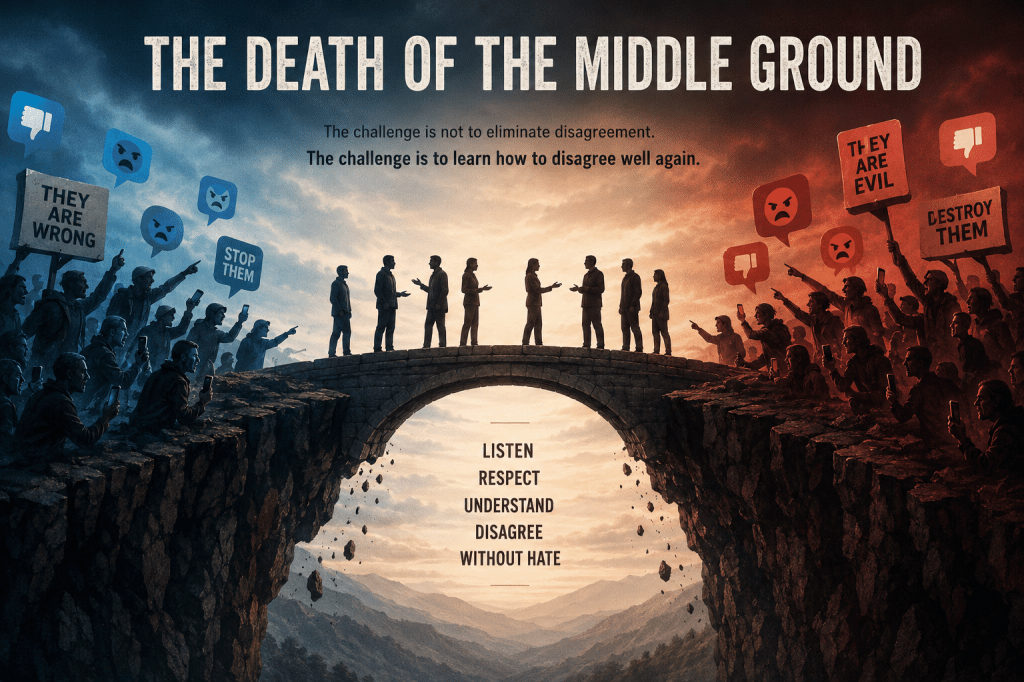
Spend ten minutes on social media and you’ll quickly discover that America is angry.
Conservatives are convinced progressives are destroying the country and that socialism is just around the corner. Progressives are convinced conservatives are destroying democracy and introducing Fascism to destroy our liberties. Every election is described as the most important in history. Every controversy becomes a moral emergency. Every disagreement is framed as a battle between good and evil.
If you spend enough time online, you might conclude that Americans have never been more divided. But I wonder if that’s really true.
America has always been a nation of disagreement. It only takes a brief look at our history to see that this is true. We have argued about religion, politics, economics, education, immigration, war, race, and countless other issues. Some of those disagreements have been intense enough to divide families, split churches, reshape political parties, and alter the course of the nation itself. Disagreement is not new in America.
In fact, disagreement has often been one of America’s greatest strengths. The founders disagreed. Religious leaders disagreed. Political parties disagreed. Citizens disagreed. The expectation was never that everyone would think alike. The expectation was that ideas would be tested through debate, persuasion, and experience and in the end, peace and tranquility would be maintained through compromise.
What is perhaps most troubling today is not that we disagree, but that we seem to be changing how we think about disagreement itself. Previous generations often viewed disagreement as a problem to be debated. Increasingly, we view disagreement as proof that the other person is morally defective. You’re not just wrong, you are evil.
For much of our history, Americans encountered disagreement within institutions that required ongoing relationships. We worshiped together. We served on civic committees together. We attended community meetings together. We worked together. We coached our children’s baseball teams together. The person whose politics irritated you was still your neighbor. The church member whose views frustrated you still sat beside you on Sunday morning. The coworker who saw the world differently was still someone you shared lunch with on Monday.
Those relationships mattered. They reminded us that human beings are more complicated than their opinions. They taught us that disagreement and respect could coexist. They forced us to recognize that intelligent, decent people sometimes arrive at very different conclusions.
Today many of those institutions have weakened, and social media has increasingly become our public square. Unfortunately, social media was never designed to help us understand one another. It was designed to capture our attention. The more time we spend scrolling, commenting, sharing, and reacting, the more valuable we become to advertisers. And few things capture attention more effectively than outrage. We have outrage to spare in today’s social media environment. Influencers, activists, and organizers frequently wield righteous anger, fear, and indignation as powerful tools of persuasion.
Anger keeps us engaged. It makes us want to fight back. Fear keeps us watching, waiting for the next attack. Indignation keeps us clicking, looking for the next sign of injustice. The algorithms have learned what sensationalist publishers have known for generations: calm and thoughtful discussion rarely goes viral. Conflict almost always does.
As a result, the loudest voices become the most visible voices. The most extreme activist on the left begins to represent “the left.” The most extreme activist on the right begins to represent “the right.” Before long, millions of Americans find themselves reacting not to their actual neighbors but to carefully selected examples of the most provocative people on the other side.
Add to this the moral certitude of those who know they will never have to face the target of their criticism and you create an environment where disagreement quickly turns into contempt. It becomes easier to question motives than arguments, easier to attack character than ideas, and easier to assume the worst than seek understanding.
The result is a growing belief that everyone is becoming more extreme. Yet most Americans don’t actually live at the ideological edges. Most people hold a mixture of views. They support some policies and oppose others. They hold convictions that don’t fit neatly into partisan categories. Like most human beings, they wrestle with competing values and imperfect choices. Real life is complicated.
But let’s face it, complexity doesn’t perform well online. Nuance doesn’t fit into a meme and humility rarely generates clicks. Certainty does, especially when it is delivered in all caps with a link to someone who already agrees with you.
History offers an important lesson here. A century ago, American Protestants engaged in one of the most significant religious conflicts in our nation’s history. The Modernist-Fundamentalist controversy divided denominations, seminaries, churches, and religious leaders. The dispute touched questions of science, biblical interpretation, theology, and the relationship between faith and modern culture. It was passionate, deeply consequential, and often painful.
Yet for all its intensity, the conflict generally unfolded through institutions that demanded serious engagement. Participants wrote books. They delivered lectures. They debated in denominational assemblies. They published articles and responded to criticism. The arguments lasted for decades because people were expected to explain their reasoning and defend their ideas.
More recently, the United Methodist Church experienced its own painful division over questions of sexuality, gender, and inclusion. In some ways, the two conflicts were remarkably similar. Both wrestled with a fundamental question: How should a religious community respond when long-held traditions encounter changing cultural understandings? In both cases, one side emphasized adaptation while the other emphasized continuity. In both cases, sincere people reached very different conclusions about faithfulness, authority, and the future of the church. But there was also an important difference.
The earlier conflict occurred in a culture that still expected extended argument and patient deliberation. The Methodist conflict unfolded in a world shaped by social media, instant communication, online activism, and twenty-four-hour commentary. The underlying issues were no less serious and the participants were no less sincere, but the environment had changed.
Complex arguments were reduced to slogans. Questions became tied to identities. Theological disagreements became intertwined with questions of personal morality and legitimacy. Participants increasingly encountered caricatures of their opponents rather than the strongest versions of opposing arguments.
That shift reflects something larger than any single church controversy. Previous generations generally treated disagreement as something to be examined, challenged, debated, and tested. Increasingly, we treat disagreement as evidence that the other person is ignorant, hateful, selfish, or morally compromised. Once disagreement becomes a judgment of character rather than a discussion of ideas, meaningful conversation becomes almost impossible.
In the era of instant and constant communication created by social media, conflict becomes something different. To be sure, conflict was not caused by social media. The issues are real and would have existed regardless. What social media changed is how the conflict is experienced.
That distinction matters. When we constantly encounter opposing viewpoints through outrage-driven platforms, we begin to assume the worst about people who disagree with us. We stop asking whether they might have reasons for their beliefs. We stop listening long enough to understand those reasons. Eventually we stop seeing fellow citizens altogether. All we see are enemies who need to be defeated, and our words are bent to that task.
At least in the minds of some observers, this may be the greatest danger facing our culture today. A healthy society does not require unanimous agreement. It never has. The goal of a free people is not to eliminate disagreement but to create conditions where disagreement can coexist with mutual respect. Democracy, community, friendship, and even family depend upon that principle.
The future of our nation will not be determined by whether conservatives defeat progressives or progressives defeat conservatives. It will not be determined by whether one ideology finally triumphs over another. It will more likely be determined by whether ordinary Americans can recover the ability to argue passionately without hating one another, to defend convictions without questioning the humanity of those who disagree, and to recognize that no political movement, religious tradition, or ideological tribe possesses a monopoly on wisdom.
It is encouraging to believe we have not lost the ability to think. Neither have we lost the ability to speak. Sadly, what may be slipping away is our willingness to listen to those with whom we disagree. A society can survive disagreement. In fact, disagreement is often the source of its strength. New ideas emerge through disagreement. Bad ideas are exposed through disagreement. Democracies depend upon disagreement. What a society cannot survive indefinitely is the belief that disagreement itself is evidence of evil—that anyone who reaches a different conclusion must therefore be ignorant, malicious, or beyond redemption.
The challenge before us is not to eliminate disagreement.
The challenge is to learn how to disagree well again.


