Some things just set me off
Everyone has a pet peeve. Some people are irritated by slow drivers in the passing lane. Others can’t stand people who leave shopping carts in the middle of a parking lot. Mine is a little different. What bothers me is watching words lose their meaning because people find them useful for advancing a narrative.
Words are among the most important tools we possess. They allow us to describe reality, exchange ideas, challenge assumptions, persuade others, and understand people whose experiences differ from our own. The value of language rests on a simple premise: words should mean what they mean. The moment we begin choosing words primarily for their emotional impact rather than their accuracy, language stops serving truth and starts serving power. That shift is becoming increasingly visible in our politics, our media, and especially our social media conversations.
The problem is not that people disagree. Disagreement is both inevitable and healthy in a free society. The problem is that we increasingly choose language designed to discredit opponents rather than understand them. Instead of describing what someone believes, we assign them a label. Instead of evaluating arguments, we question motives. Instead of persuading, we condemn. The result is a public conversation that generates enormous amounts of outrage while producing very little understanding.
One of the clearest examples can be found in the way political labels are used today. Words such as fascist, extremist, radical, threat to democracy, and even Nazi once described specific political movements or identifiable behaviors. These terms still have legitimate uses. History contains genuine fascists, genuine extremists, and genuine threats to democratic institutions. The problem arises when these words become catch-all descriptions for anyone whose views we strongly oppose.
In contemporary political discourse, the same individual may be described as a fascist by one side and a defender of democracy by the other. The labels often reveal more about the speaker than the person being described. Rather than helping us understand political movements, these terms frequently function as shortcuts that allow us to dismiss entire groups of people without engaging their arguments. Once someone has been labeled a fascist, there is little incentive to ask whether their ideas have merit. The label itself performs the work that evidence and argument once did.
The same pattern appears in our moral vocabulary. Consider how frequently the word hate appears in modern discourse. Hatred is a real and destructive force, and history provides countless examples of the damage it can cause. Yet disagreement is not the same thing as hatred. A person may oppose a policy without hating the people affected by it. Someone may disagree with a social movement without harboring hostility toward those who support it. Citizens in a pluralistic society will inevitably disagree about questions of religion, morality, education, economics, and public policy. If every disagreement is interpreted as evidence of hatred, then meaningful debate becomes impossible because disagreement itself becomes a moral offense.
Related terms such as bigot, racist, sexist, and phobic often suffer from the same inflation. These words describe serious forms of prejudice and should not be treated lightly. Yet they are increasingly deployed as rhetorical weapons against anyone who questions a prevailing view. The accusation itself becomes the argument. Rather than demonstrating prejudice, people simply assume it. Rather than persuading opponents, they seek to shame them into silence. In the process, words that once identified genuine injustice become less effective at identifying it because they are applied so broadly.
A similar trend has emerged through the popularization of psychological terminology. Social media has introduced millions of people to concepts that were once largely confined to clinical settings. Terms such as gaslighting, narcissist, trauma, triggered, and toxic now appear in everyday conversation. There is nothing wrong with broader public awareness of mental health issues. In fact, much of that awareness has been beneficial. The difficulty arises when clinical language is expanded to describe virtually every unpleasant human interaction.
A disagreement becomes gaslighting. A selfish person becomes a narcissist. An uncomfortable experience becomes trauma. A difficult relationship becomes toxic. Being upset becomes being triggered. The original concepts become stretched far beyond their intended meanings. As a result, the language loses its precision and our ability to distinguish between genuinely serious conditions and ordinary human struggles begins to erode.
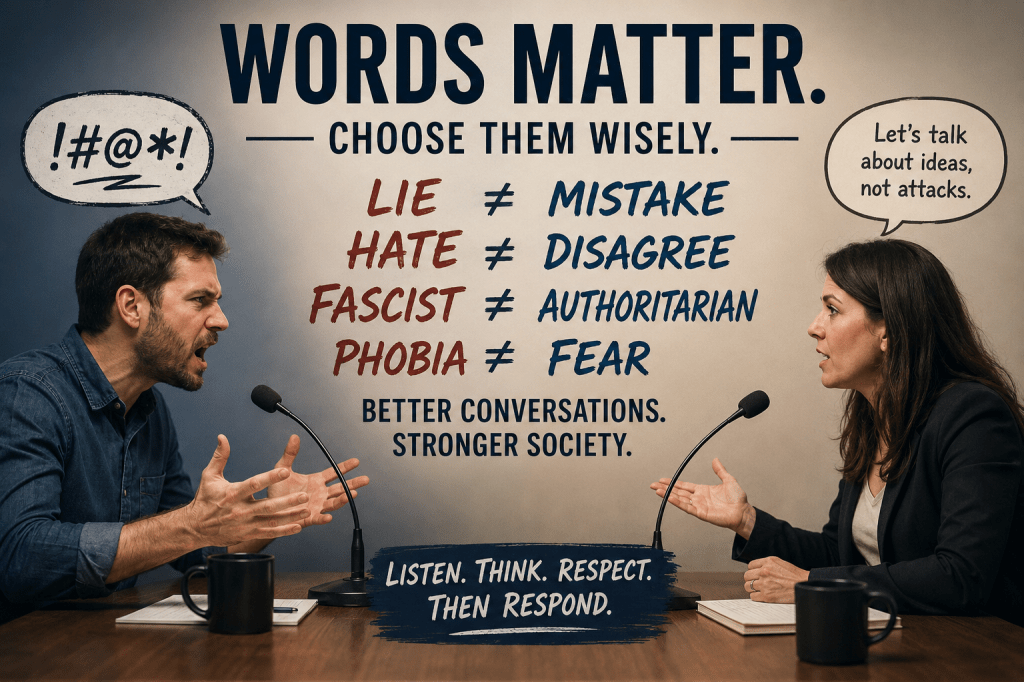
The common thread running through all of these examples is not political ideology, social philosophy, or even partisanship. The common thread is the gradual erosion of distinctions. Language functions best when it helps us recognize differences between related ideas. A lie is not the same thing as a mistake. A failed prediction is not the same thing as a lie. Disagreement is not the same thing as hatred. Fear is not necessarily prejudice. Selfishness is not narcissism. Being offended is not trauma. These distinctions may seem small, but they are essential to clear thinking. When we stop making them, we stop evaluating ideas carefully and begin reacting emotionally to labels.
This is why the issue is larger than politics. At its heart, it is a question of literacy. Literacy is often defined as the ability to read and write, but in a broader sense it involves the ability to understand ideas, recognize nuance, evaluate evidence, and distinguish between concepts that are similar but not identical. A literate society understands that precision matters. It understands that words are tools for describing reality, not merely instruments for winning arguments.
Unfortunately, many of the incentives that shape modern communication push us in the opposite direction. Social media platforms reward engagement, and engagement is often driven by outrage. Nuance rarely goes viral. Precision is seldom shared thousands of times. The careful explanation that acknowledges complexity is routinely outperformed by the simple accusation that divides the world into heroes and villains.
Consider the difference between saying, “I believe that policy will have harmful consequences,” and saying, “That policy is hateful.” The first statement invites discussion. It leaves room for evidence, debate, and persuasion. The second statement transforms a disagreement about policy into a judgment about character. Once that happens, the focus shifts away from whether the policy is good or bad and toward whether the people who support it are good or bad.
The same dynamic appears throughout our public conversations. “I think you’re mistaken” becomes “You’re lying.” “I disagree with your position” becomes “You’re a bigot.” “Your argument has authoritarian tendencies” becomes “You’re a fascist.” In each case, the language moves away from describing ideas and toward condemning people. The stronger accusation generates a stronger emotional response, which is precisely why it is so attractive in a media environment that rewards attention above all else.
What makes this trend particularly troubling is that it undermines one of the most important habits of democratic life: the ability to disagree with someone without questioning their humanity. Democracies are built on the assumption that reasonable people can hold different views about complicated issues. They require citizens who can engage opponents, challenge assumptions, defend their positions, and occasionally admit they were wrong. None of those things are possible when every disagreement is interpreted as evidence of malice, ignorance, hatred, or moral deficiency.
Perhaps that is the most significant cultural shift of our time. Previous generations often viewed disagreement as a problem to be debated. Increasingly, we view disagreement as proof that the other person is morally defective. We no longer ask, “Why does this person think differently than I do?” Instead, we ask, “What kind of person would think differently than I do?” The first question invites understanding. The second invites condemnation.
This shift helps explain why so many conversations seem incapable of producing resolution. If I believe my opponent is simply mistaken, there is a possibility that evidence, experience, or reasoned discussion might change one of our minds. If I believe my opponent is hateful, fascist, phobic, toxic, or dishonest by nature, there is little reason to engage them at all. The conversation is effectively over before it begins. Labels replace arguments. Motives replace evidence. Outrage replaces understanding.
None of this means we should abandon strong language when it is warranted. There are lies. There is hatred. There are genuine extremists. There are people who manipulate others psychologically. There are prejudices that deserve to be confronted directly and honestly. The answer is not to stop using these words. The answer is to use them carefully and accurately.
Strong words carry moral weight because they describe serious realities. When we apply them indiscriminately, we diminish their value. A society that calls every political opponent a fascist may eventually struggle to recognize actual authoritarianism. A culture that labels every disagreement as hate may find it difficult to identify genuine hatred when it appears. A public conversation that treats every uncomfortable experience as trauma risks trivializing the suffering of those who have endured truly traumatic events.
The irony is that many people use exaggerated language because they believe the issues they care about are important. Yet exaggeration often weakens the very arguments it is intended to strengthen. Credibility depends upon precision. People are more likely to trust those who describe reality carefully than those who reach immediately for the most inflammatory label available.
My pet peeve may sound trivial at first. It is, after all, a complaint about words. But words shape thoughts, and thoughts shape actions. The way we speak influences the way we understand one another and the way we understand the world around us. When language becomes detached from meaning, our ability to reason together begins to deteriorate.
Perhaps the solution begins with a simple commitment to intellectual honesty. Call a lie a lie, but only when someone intends to deceive. Call hate hate, but only when genuine hostility exists. Call fascism fascism, but only when the label accurately describes reality. Use strong words when strong words are deserved, but resist the temptation to use them merely because they advance a narrative or damage an opponent.
In the end, a healthy society requires more than freedom of speech. It requires discipline in speech. The more carefully we use our words, the more clearly we can think. And in an age increasingly defined by outrage, tribalism, and ideological division, clear thinking may be one of the most important civic virtues we have left.

 Good Sense - A Discussion of Culture and Issues in America Today