Are We Becoming Easier to Manipulate?

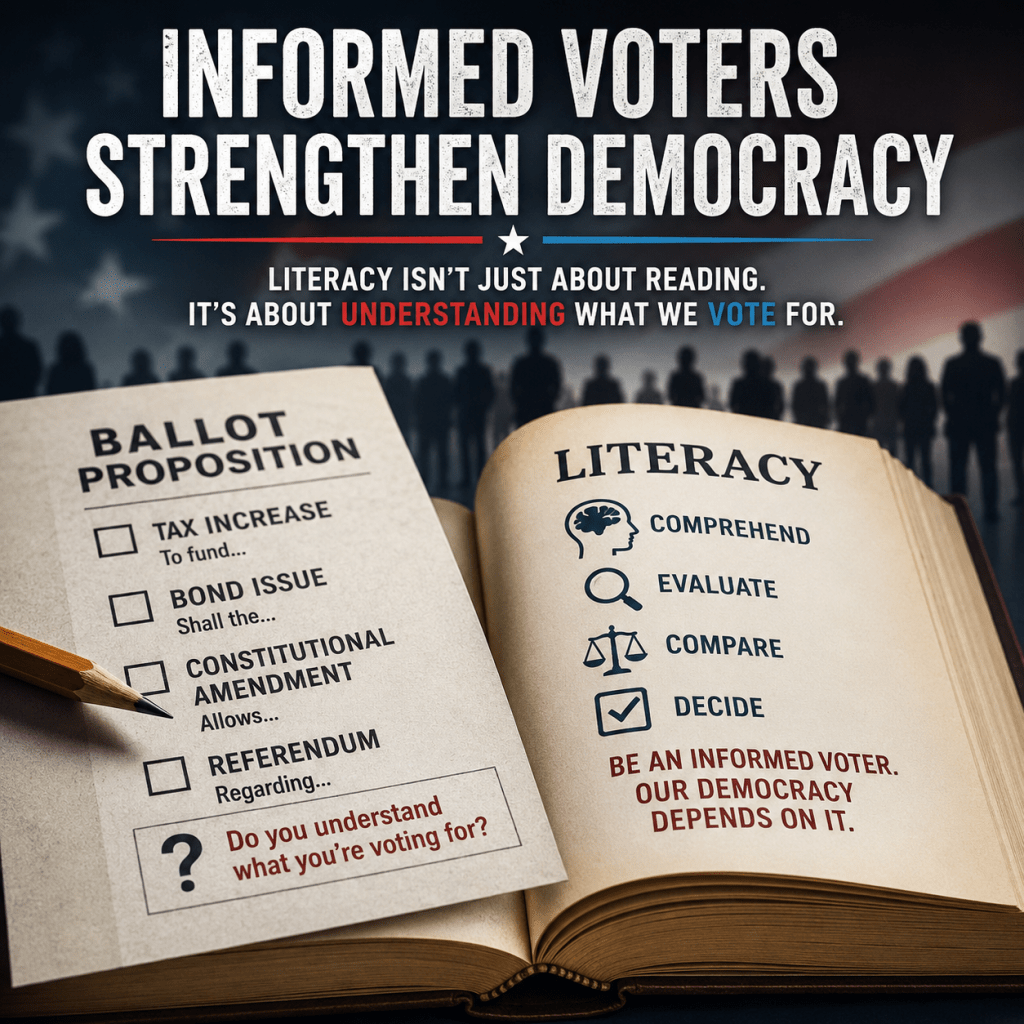
I recently read a study examining the relationship between literacy and voting. What caught my attention wasn’t the politics. It was the literacy.  As I ready through the article I was reminded of several recent interactions on Facebook posts with people who seemed to understand the words they were reading but lacked the ability to think critically through the arguments and make informed decisions.  I think we need to take a closer look at this issue.

For years we’ve been told that Americans are becoming more educated. In one sense, that’s true. High school graduation rates are higher than ever, and a larger percentage of Americans hold college degrees than any previous generation. But researchers are increasingly pointing out that educational attainment and literacy are not the same thing.

Educational attainment measures how many years of school we completed or what degrees we earned. Literacy measures something different: our ability to understand information, evaluate arguments, recognize contradictions, weigh evidence, and apply what we learn to real-world decisions.

Recent national and international assessments found that nearly three in ten American adults now score at the lowest levels of literacy proficiency, a significant increase from just a few years ago. Even more concerning, literacy scores declined across every educational attainment level, including among college-educated adults. (Institute of Education Sciences)

Take a look at that again.  Literacy scores are declining across every educational attainment level.  That’s a cause for concern, because literacy matters for far more than reading books. It affects our ability to understand economic policy, healthcare proposals, foreign affairs, legal questions, scientific claims, and the endless stream of statistics and competing narratives that flood our news feeds every day.

Researchers define literacy not simply as reading words but as the ability to comprehend, evaluate, and use information. (APM Research Lab) This is where elections come in.  One recent study found that many ballot propositions are written at reading levels well above the abilities of large portions of the voting population. In fact, while 39% of adults have a high school education or less, nearly three-quarters of ballot measures were written above that reading level. (Sage Journals)

But the issue goes beyond ballot initiatives. Every election cycle we are asked to evaluate candidates making claims about taxes, healthcare, immigration, crime, education, government spending, foreign policy, and dozens of other complex issues. A healthy democracy does not require every citizen to be an expert. But it does require citizens who can ask questions, examine evidence, challenge their own assumptions, and look beyond slogans and talking points.

When literacy declines, public debate can become more emotional, more tribal, and more dependent on simple narratives that confirm what we already believe. The question is not whether people have the right to vote. They absolutely do. The question is whether we are doing the work required to be informed voters.

As we approach another election season, perhaps the most important civic question is not “Who are you voting for?” Perhaps it is: “How do you know what you know?”

I’d be interested in hearing what others think. Is America becoming better informed, less informed, or simply overwhelmed by the amount of information competing for our attention?

#GoodSense

Tired of Being Misled!

“False testimony my be refuted, but once it is voiced, everyone repeats it” Proverbs 21:28 as translated by Rabbi Rami M. Shappiro

Ok, so have you visited social media any time recently? Or how about have you watch the news on TV or cable? Have you read the newspaper? If the answer is yes, then you may agree with me that it seems like there is no way to know what is true any more. Raise your hand if you agree.

I may just be speaking for myself, here, but I am really tired of reading posts or watching stories that are filled with “spin.” It seems like every person’s goal is simply to prove their own point of view without consideration for what is actually true or right or good or valuable. There are so many examples of this that it is hard to decide which ones to use. Here is one.

On a recent newscast a reporter declared that President Trump had contradicted his own leading scientists regarding the expected availability of a vaccine for the corona virus. They went on to play a recorded clip from the President followed by one from the head of the CDC as proof of the contradiction. They also threw in a clip from Dr. Fauchi to further support their contention. On the surface, it appeared their complaint was valid. But wait a minute…

A simple review of the larger context of the statements by all three people reveals that maybe the story is not quite so simple. It turns out that the President was talking about how quickly a vaccine might be available to distribute to a broad segment of the population that are most at risk from the virus while the CDC Director was talking about how quickly the vaccine would be available for the “majority” of Americans. Those are actually two very different things. And, to top it all off, it turns out Dr. Fauchi agreed with both the President and the CDC Director.

What bothers me the most here is not whether or when a vaccine will be available. What bothers me is the apparent effort by the media to twist the facts of the story (because after all, these are all facts) in order to promote a narrative that attempts to discredit the President. I know they don’t like him. I know they don’t agree with him. I know they would like to see him voted out of office. But this is a form of deception that is insidious and dangerous. It threatens our culture because it diminishes the trustworthiness of the free press.

What makes it worse, in my view, is the way so many Americans are quick to pick up on such a story and spread it immediately and without criticism across social media. In a world where fewer and fewer people actually watch the news or read the papers, social media has become the source of much of what we know about our world. It is a powerful tool for both good and evil and it is being used for both purposes. When people uncritically repeat so called “facts” in social media they often unwittingly spread falsehoods. And the industry “fact checkers” are no help at all. Their purported objectivity is so obviously biased that it is laughable to call it anything but censorship and propaganda.

Once a story like this hits the media, whether broadcast or social, it seems unstoppable. Solomon saw the problem thousands of years ago. A false story, once started, even if it is proved false, will continue to spread. And why is that? It is because people continue to repeat it without discrimination. If it fits their preconceived ideas then it is repeated and promoted without hesitation. And of course, if you challenge someone who posts this information, you are likely to be attacked, called a fool, ridiculed, and/or dismissed.

Don’t be fooled. As we move quickly toward what could be the most important national election in a century or more, I want to urge people to be discerning. Ask more questions. Be slow to accept and even slower to respond. Look past the spin no matter where it comes from and treat every story with a healthy dose of skepticism. Don’t think that you already know – remember what Solomon wrote, “Know-It-Alls display their ignorance.” Don’t be an know-it-all and don’t spread false reports.

Shalom,

Kevin