The Casualty List: The Myth of the “Just Transition” for Healthcare Workers

Part 3 in the Medicare for All House of Cards Series
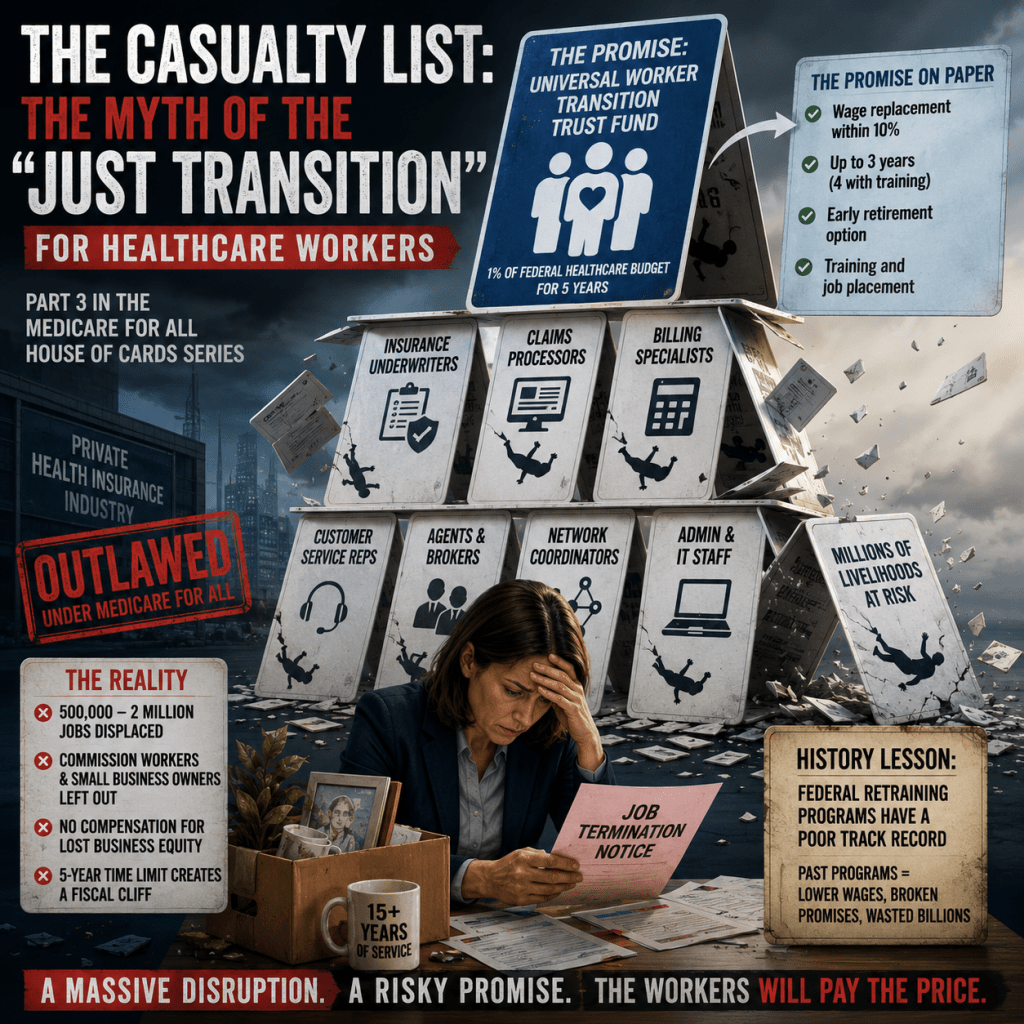
Medicare for All sounds like a great solution to the problems in the US healthcare system, but when people talk about it they often do so without any recognition of the human cost of making this kind of structural change.  Implementing this plan would completely eliminate the health insurance industry and severely decrease opportunities for hundreds of thousands of Americans in businesses tied to that industry.  This cost must be added to the assessment of the overall plan.

The policy makers putting forth the Medicare for All plan are fully aware of the potential impact on the workforce.  When policymakers discuss these types of massive structural shifts, they frequently lean on a comforting euphemism: the “just transition.” In the Medicare for All Act of 2025 (S.1506/H.R.3069)¹, this concept takes the form of a federally funded worker transition program. Recognizing that a single-payer system would eliminate the private commercial health insurance market, the bill’s supporters promise to protect the livelihood of every displaced worker.

It is a noble promise, but it runs up against a significant logistical reality. A 2018 economic analysis by researchers at the Political Economy Research Institute (PERI) at UMass Amherst, a study conducted in support of Medicare for All, not against it, estimated that eliminating the private insurance and medical billing bureaucracy would displace approximately 1.8 million workers, including nearly 300,000 aged 60 or older.² A critical look at the funding mechanism and America’s historical record with federal job-retraining reveals real reasons for caution.

The Legislative Blueprint

The bill text provides for wage replacement, continued retirement and pension benefits, job training and placement, preferential hiring for displaced workers into new government roles, and education benefits.¹ Beyond that general framework, the precise formulas, how long wage support lasts, how it’s calculated for workers with variable income, and how tightly the transition period is bounded, are not fully specified in the bill text as introduced, leaving important implementation details to be worked out administratively.

This creates real ambiguity for certain groups. Independent insurance agents and brokers whose income relies on fluctuating commissions and policy renewals present a genuine complication: calculating a fair wage-replacement baseline for a self-employed contractor is more complex than for a salaried employee, and the bill does not appear to address the loss of a broker’s “book of business,” an active client portfolio that functions as a sellable asset, as a compensable loss.

The Structural Vulnerability of the Funding Model

Rep. Jayapal has publicly confirmed the funding mechanism: 1% of the total cost of the bill, set aside annually for five years, to support displaced workers.³ If, as estimates suggest, the single-payer budget runs $3–3.4 trillion annually, that translates to roughly $30–34 billion a year for worker transition.  This money comes out of the same overall health care budget, rather than from a separate, dedicated fund. That creates a structural tension: every dollar spent on severance, retraining, and placement services for displaced workers is a dollar not spent on direct patient care. And because the fund is bounded at five years, the program faces a hard cutoff if structural unemployment in this sector proves more persistent than anticipated.

The Historical Record: Why Federal Retraining Often Falls Short

Proponents argue that unprecedented funding levels will succeed where past programs failed. But America’s track record with federal job retraining gives real reason for skepticism. The clearest example is Trade Adjustment Assistance (TAA), the flagship federal program for retraining manufacturing workers displaced by trade. A rigorous 2012 evaluation conducted by Mathematica Policy Research for the U.S. Department of Labor, using a matched comparison group of similar displaced workers who did not participate in TAA, found that TAA participants earned about $3,300 less annually than their non-participating counterparts in the final year of the multi-year follow-up period, and calculated the program’s overall net benefit to society as negative.⁴ The researchers noted this may partly reflect the time it takes older, long-tenured workers to successfully retrain, a dynamic that could plausibly recur among displaced insurance-industry workers, many of whom are older, specialized administrative staff. Coal-to-clean-energy retraining programs offer a second cautionary parallel: these initiatives have consistently struggled with geographic and skill mismatches between displaced workers and available new jobs.

The Bottom Line

The Worker Transition program relies on succeeding where comparable federal efforts have historically struggled. Generous funding can pay for training and temporary income support, but it cannot guarantee that hundreds of thousands of specialized insurance and billing workers will find comparable new roles on the timeline the bill anticipates. The gap between the money committed and the outcomes historically achieved by similar programs is worth taking seriously before assuming this transition will go smoothly.

Let’s be clear, the problem with the Sanders plan isn’t a lack of funding for workers; it is a fundamental misunderstanding of labor logistics. Throwing $150 billion at a problem can buy tuition and extend unemployment checks, but it cannot instantly manufacture hundreds of thousands of vacant, high-paying, white-collar jobs that perfectly match the skills of displaced corporate insurance workers. Shifting an entire workforce by government decree is an incredibly slow, friction-heavy process. By limiting the trust fund to a strict five-year window, the plan assumes an economic agility that the federal government has never historically been able to deliver.


Sources

  1. Medicare for All Act, H.R. 3069, 119th Cong. (2025); S. 1506, 119th Cong. (2025). Full text: congress.gov/bill/119th-congress/house-bill/3069/text
  2. Pollin, R., Heintz, J., Arno, P., Wicks-Lim, J., & Ash, M. (2018). Economic Analysis of Medicare for All. Political Economy Research Institute, University of Massachusetts Amherst, Appendix 6: “Estimating Displaced Workers.” peri.umass.edu/publication/economic-analysis-of-medicare-for-all
  3. Jayapal, P., quoted in “‘Medicare-for-all’ sponsor says plan would gut 1 million private insurance jobs,” Fox News (2019). foxnews.com/politics/medicare-for-all-would-gut-a-million-private-insurance-jobs
  4. Schochet, P.Z., D’Amico, R., Berk, J., Dolfin, S., & Wozny, N. (2012). Estimated Impacts for Participants in the Trade Adjustment Assistance (TAA) Program Under the 2002 Amendments. Mathematica Policy Research, prepared for the U.S. Department of Labor. dol.gov/sites/dolgov/files/ETA/publications/ETAOP_2013_08.pdf

For Further Reading: Sources for the “House of Cards” Medicare for All Series

This document consolidates every source used to verify claims across all three essays in the Medicare for All series, plus additional context readers may find useful. Organized by topic.

The Bill Itself

Federal Cost Estimates

  • Blahous, C. (2018). The Costs of a National Single-Payer Healthcare System. Mercatus Center at George Mason University. Estimated ~$32.6 trillion in added federal costs over 10 years (2022–31), using assumptions favorable to the plan’s proponents as a lower-bound estimate. mercatus.org — “How the Urban Institute’s Estimates of Medicare for All Costs Stack Up”
  • Urban Institute & Commonwealth Fund (2019). From Incremental to Comprehensive Health Insurance Reform. Estimated ~$32–34 trillion in added federal costs over 10 years (2020–29). urban.org/research/publication/estimating-cost-single-payer-plan
  • Congressional Budget Office (December 2020). How CBO Analyzes the Costs of Proposals for Single-Payer Health Care Systems. Modeled four illustrative single-payer designs; savings ranged from $42 billion to $743 billion in 2030 depending on assumptions, with the closest match to current bills (“Option 3”) yielding roughly $650 billion in savings — the source of the frequently cited “$650 billion” figure. Note: this is an analysis of illustrative design options, not a formal score of H.R. 3069/S. 1506. cbo.gov/publication/56898
  • Pollin, R., Heintz, J., Arno, P., Wicks-Lim, J., & Ash, M. (2018). Economic Analysis of Medicare for All. Political Economy Research Institute (PERI), UMass Amherst. A study conducted in support of the 2017 Sanders bill; estimated net national health spending would fall by about 9.6% under the plan. peri.umass.edu/publication/economic-analysis-of-medicare-for-all
  • Yale School of Public Health study (Galvani et al., 2020), published in The Lancet — estimated Medicare for All could save approximately 68,000 lives and reduce health spending by roughly 13% (~$450 billion) annually. Referenced in: Public Citizen, “Fact Check: Medicare for All Would Save the U.S. Trillions”

Worker Displacement and Transition

  • PERI (2018), Appendix 6: “Estimating Displaced Workers” — estimated approximately 1.8 million workers displaced from private health insurance and related administrative roles, including nearly 300,000 aged 60 or older. Same source as above.
  • Jayapal, P. — public statement confirming the “1% of total bill cost, set aside annually for five years” worker transition funding mechanism, and a separate public estimate of “about a million” displaced workers. Reported in: Fox News, “‘Medicare-for-all’ sponsor says plan would gut 1 million private insurance jobs” (2019)
  • Schochet, P.Z., D’Amico, R., Berk, J., Dolfin, S., & Wozny, N. (2012). Estimated Impacts for Participants in the Trade Adjustment Assistance (TAA) Program Under the 2002 Amendments. Mathematica Policy Research, prepared for the U.S. Department of Labor. Found TAA participants earned about $3,300 less annually than a matched comparison group in the final follow-up year; overall net benefit to society calculated as negative. dol.gov/sites/dolgov/files/ETA/publications/ETAOP_2013_08.pdf
  • U.S. Department of Labor, “National Evaluation of the Trade Adjustment Assistance Program” — background on TAA program design and participation rates. dol.gov/agencies/eta/research/publications/national-evaluation-trade-adjustment-assistance-program

International Comparisons

Independent Fact-Checking and Context

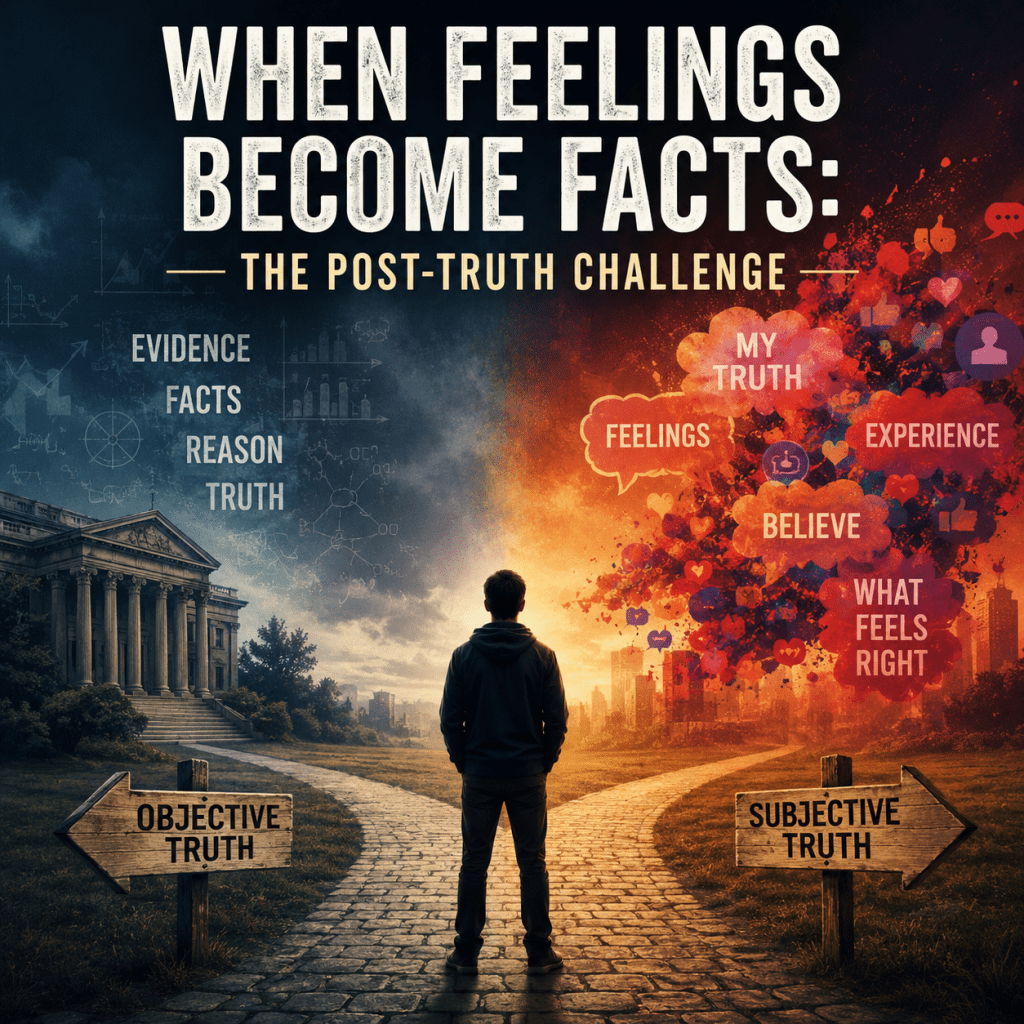
Navigating the Post-Truth Era: Balancing Facts and Feelings

Over the past century, Western societies have increasingly expanded the authority granted to subjective experience in defining personal identity and public life. This development has brought new insights into human experience while also creating difficult questions about how subjective experience should relate to empirical evidence, shared institutions, and democratic decision-making.

This may describe one of the most significant cultural changes of the modern era. For most of Western history, truth was understood to exist outside ourselves. Whether grounded in God, nature, science, law, or long-established institutions, truth was assumed to be something that individuals discovered rather than created. Personal experience certainly mattered, but it was generally viewed as one source of knowledge among many. Experience could illuminate reality, but it did not define reality.

Over the last century, that balance has gradually shifted. Our culture has increasingly elevated subjective experience from being evidence about the world to becoming an authority over the world. The question has subtly changed from “What is true?” to “What is true for me?” This shift has produced genuine benefits. It has encouraged greater attention to mental health, increased awareness of trauma, and given voice to people whose experiences were too often dismissed or ignored. It has reminded us that statistics do not tell every human story and that empathy requires listening before judging. But every cultural gain comes with its own set of challenges.

When personal experience becomes the highest authority, disagreement becomes increasingly difficult. If my deepest feelings define reality, then questioning my conclusions can feel like questioning my identity. Debate no longer concerns competing interpretations of evidence; it becomes a conflict between competing personal realities. This helps explain why contemporary public discourse often feels so different from previous generations.

Political debates rarely stay focused on evidence for long. Scientific findings are frequently filtered through ideological commitments before they are evaluated. Social media algorithms reward emotional certainty over careful reasoning. Public conversations increasingly ask us not merely to disagree with one another but to choose which competing narratives we will inhabit. In this environment, facts often become secondary to identity. Psychologist Jonathan Haidt argues that “Intuitions come first, strategic reasoning second.” We often believe we are reasoning our way to conclusions when we are actually defending conclusions our emotions have already reached.

The modern phrase “my truth” captures this transformation perfectly. It usually does not mean “my perspective” or “my experience.” It often suggests that personal experience possesses its own independent authority regardless of whether it corresponds with external reality.

This is one reason the phrase “post-truth” has become so common. A post-truth society is not necessarily one in which facts disappear. Rather, it is one in which facts lose their ability to settle disagreements because different groups no longer recognize the same standards of authority. Hannah Arendt warned more than fifty years ago that “Freedom of opinion is a farce unless factual information is guaranteed.” Democracy depends on vigorous debate, but debate becomes impossible if citizens no longer share a common understanding of basic facts.

“Freedom of opinion is a farce unless factual information is guaranteed.”
— Hannah Arendt, Truth and Politics (1967)

History offers an interesting parallel. During the Modernist-Fundamentalist conflict of the early twentieth century, Christians fiercely debated the authority of Scripture, science, historical criticism, and religious experience. Both sides appealed to sources outside themselves—even when they disagreed profoundly about which sources deserved the greatest authority. The central question was, “What should count as authoritative?”

Today’s cultural conflicts often ask a different question altogether. Increasingly, authority itself is being relocated into the individual. Personal authenticity has become the highest moral value. To deny someone’s internal understanding of themselves is frequently seen not merely as disagreement but as harm. This development can be seen in debates over gender identity, politics, race, religion, and countless other issues. These debates are not simply disagreements about policy. They reflect competing understandings of where truth ultimately resides. Competing world views that are increasingly incompatible.

One worldview continues to believe that reality exists independently of us and that our responsibility is to discover and understand it as honestly as possible. The other increasingly argues that our internal experience plays a central role in defining who we are and how society should recognize us. Neither position is entirely wrong, but the conflict between them makes it ever more difficult to reconcile the two.

Objective facts without compassion can become cold and dehumanizing. Human beings are more than data points, and every statistic represents real lives with real experiences. Yet subjective experience without objective reference points creates its own dangers. If every deeply held conviction becomes equally authoritative, society loses the shared standards necessary for resolving disagreements peacefully. Democracy depends upon citizens who can disagree while still appealing to common evidence, common language, and common institutions. That may be the greatest challenge facing contemporary culture. 

The real danger of the post-truth age is not that people tell more lies than previous generations. Human beings have always distorted the truth when it served their interests. The deeper danger is that we increasingly lack agreement about what counts as truth in the first place. Once that happens, every disagreement becomes a struggle for power rather than a search for understanding.

Everyone is entitled to his own opinion, but not to his own facts.

Daniel Patrick Moynihan

Perhaps recovering healthy public discourse does not require choosing between objective facts and subjective experience. We need both. Human experience often raises important questions that demand our attention. Empirical evidence helps us test our conclusions. Compassion reminds us why the discussion matters. Humility reminds us that none of us sees the whole picture.

Truth has always required both careful observation and honest self-examination. The challenge before our generation is not deciding whether feelings matter. They do. The challenge is remembering that feelings, however deeply felt, are not the same thing as facts. A healthy society requires both empathy for individual experience and a shared commitment to realities that exist beyond ourselves. Only then can disagreement become what it ought to be—not a battle between competing identities, but a common search for what is true.

Selected References for Further Reading

Foundational Works on Truth, Identity, and Modern Culture

Arendt, Hannah. Between Past and Future: Eight Exercises in Political Thought. New York: Viking Press, 1961. (See especially the essay “Truth and Politics,” added in the 1968 edition.)

Bellah, Robert N., Richard Madsen, William M. Sullivan, Ann Swidler, and Steven M. Tipton. Habits of the Heart: Individualism and Commitment in American Life. Berkeley: University of California Press, 1985.

Berger, Peter L., Brigitte Berger, and Hansfried Kellner. The Homeless Mind: Modernization and Consciousness. New York: Random House, 1973.

Cassam, Quassim. Vices of the Mind: From the Intellectual to the Political. Oxford: Oxford University Press, 2019.

Haidt, Jonathan. The Coddling of the American Mind: How Good Intentions and Bad Ideas Are Setting Up a Generation for Failure. New York: Penguin Press, 2018.

Haidt, Jonathan. The Righteous Mind: Why Good People Are Divided by Politics and Religion. New York: Pantheon Books, 2012.

Higgins, Kathleen. “Post-Truth: A Guide for the Perplexed.” Nature, Vol. 540 (2016): 9.

Keyes, Ralph. The Post-Truth Era: Dishonesty and Deception in Contemporary Life. New York: St. Martin’s Press, 2004.

Lasch, Christopher. The Culture of Narcissism: American Life in an Age of Diminishing Expectations. New York: W. W. Norton & Company, 1979.

Levin, Yuval. A Time to Build: From Family and Community to Congress and the Campus, How Recommitting to Our Institutions Can Revive the American Dream. New York: Basic Books, 2020.

MacIntyre, Alasdair. After Virtue: A Study in Moral Theory. 3rd ed. Notre Dame, IN: University of Notre Dame Press, 2007.

McIntyre, Lee. Post-Truth. Cambridge, MA: MIT Press, 2018.

Moynihan, Daniel Patrick. Daniel Patrick Moynihan: A Portrait in Letters of an American Visionary. Edited by Steven R. Weisman. New York: PublicAffairs, 2010. (Contains the frequently quoted statement, “Everyone is entitled to his own opinion, but not to his own facts.”)

Postman, Neil. Amusing Ourselves to Death: Public Discourse in the Age of Show Business. New York: Penguin Books, 1985.

Rieff, Philip. The Triumph of the Therapeutic: Uses of Faith after Freud. Chicago: University of Chicago Press, 1966.

Taylor, Charles. A Secular Age. Cambridge, MA: Harvard University Press, 2007.

Taylor, Charles. Sources of the Self: The Making of the Modern Identity. Cambridge, MA: Harvard University Press, 1989.

Trueman, Carl R. The Rise and Triumph of the Modern Self: Cultural Amnesia, Expressive Individualism, and the Road to Sexual Revolution. Wheaton, IL: Crossway, 2020.

Weaver, Richard M. Ideas Have Consequences. Chicago: University of Chicago Press, 1948.

Historical Background on American Religion and Culture

Marsden, George M. Fundamentalism and American Culture. 2nd ed. New York: Oxford University Press, 2006.

Noll, Mark A. The Scandal of the Evangelical Mind. Grand Rapids, MI: Eerdmans, 1994.

Smith, Christian. What Is a Person? Rethinking Humanity, Social Life, and the Moral Good from the Person Up. Chicago: University of Chicago Press, 2010.

I Have Been Foolish – No More!

“Fools do not want to understand anything. They only want to tell others what they think.” Proverbs 18:2 NCV

Love, Companionship, Friendship

Social media has become a dangerous place to hang out. What used to be a great way to keep in touch with friends and family and to have the occasional conversation about history or politics has become a place where people feel free to attack others without fear of repercussions. Civil discussion has devolved into angry rants punctuated by links to media sources cited as “proof” of the rectitude of each person’s ideas.

Writing in the book of Proverbs, Solomon seems to have seen some of this coming and warned us against it. He wrote that “fools” don’t participate in a conversation in order to understand and grow. All they really want is to tell others what they think. This is so prevalent in social media communication that I’m afraid it is becoming the norm. And along with it people have allowed hate, rage, and disrespect to become their norms in communication. People are so quick to place a label of hate on others. They are so impatient to prove that they are right and the others are wrong. They are absolutely determined to “prove” their position not by reasoned debate built on understanding but rather by beating the other person into submission with a barrage of angry words and hateful accusations. Everyone is either a socialist or a fascist. They are idiots or morons because they disagree with you.

In a culture at the crossroads, I fear these are signs that we are closer each day to a catastrophic break that will issue in disaster. We can already see the signs in the violence in so many places across the nation. Portland, Kenosha, Chicago, New York, Los Angeles . . . the list goes on. Protest has become riot. Riot has become open conflict with armed combatants on all sides. Deaths are on the rise and there does not appear to be any end in sight.

Political figures on both sides of the growing divide seem unwilling and unable to provide leadership. There is no vision for peace coming from any of them. The President and Republicans want to blame the Democrat leadership of the states and cities and make it their problem. The Democrats want to blame the President and Republicans, calling them out for being divisive and failing to provide unity. I believe they are all correct and all absolutely in the wrong. For none of them are willing to stand up and lead. None of them are willing to provide a vision for all Americans to follow a path toward peace. Each of them seems so focused on keeping themselves in power that they have no idea how to lead us to cultural unity and compromise.

In the absence of leadership from our elected officials, it is time for we, the people, to stand up on our own and assume the mantle of leadership. I’m not talking about political action or even public protest. I am talking about leading through influence with one another. We don’t need a politician to tell us how to behave. We already know. We need to work together to build a new consensus in our culture. We don’t have to agree, but we do need to respect, listen to and learn from one another. We need each other to be whole.

In the past six months I have been called a racist, a white supremacist, a homophobe, a narcissist, a bully, an old white man, a fool, and “boomer.” I have been labeled a “Trumper” and tagged a Fox News groupie and an NRA tool. I guess I am an old white man, LOL. At least as some people count old. But the rest of these labels just don’t fit and I reject them without any hesitation. Even more, I reject the very idea that labeling others with terms intended to demean, diminish and defeat them and their ideas is a proper way to discuss what divides us. As long as people continue to follow this path the divisions will grow and the hatred that drives those divisions will increase.

I confess, I have been guilty in the past of contributing to the anger on social media. I have written hurtful things and failed to see the person behind the post. I made a commitment to myself several months ago to cease this practice. I am doing my best to focus every time on hearing the person on the other side of my comments and taking their perspective into consideration. I am committed to doing everything possible to keep my contributions focused on not just facts, but truth. Facts can be used in countless ways to support a position, but truth takes into account how facts intersect with other facts and how perspective and preconception influence each position.

I don’t know who will read this or who will agree to it, but I hope and pray that many will choose to follow my example in this and heed my plea. Join me in a new movement in America to focus on peace and unity instead of conflict and division. Who will join me?

Shalom

Kevin

Is Our Culture Headed for War?

The stage is set for what could be the most important national election since 1860. Not since that momentous election have we been so divided as a people. Or at least is seems so to me. Our divisions touch deep into our culture and expose not just a divide or politics and policy, but an even deeper divide over core values. That, I believe, is at the heart of the choice we must make.

To understand the choice, we need to first understand at least a little bit about culture. When I use that word here, I mean to focus on the shared ideas and values that together form our common understanding of how things “should” be. In particular, I’m thinking of the values we hold as people that we believe are important enough to argue, debate, and even fight over. Those values that are important enough to organize our lives around. In other words, what matters enough for you to fight about and how far are you willing to go in that fight to translate your values into practice and policy for your community, your state, your nation.1

At every level there can be and often are competing value systems that inform culture. In a nation as large and diverse as the United States there are always competing values. We see them at every level. My values don’t always match those of my family members. My neighbors and I may disagree on a variety of issues. People in my community, my state, my region, and my nation all have values that we share and some on which we disagree. In most times and most circumstances those differences make for interesting and often spirited debate.

Culture is not simply ideas, and debate over culture is not the same as debate or discussion about ideas. Culture is made evident in living and its values are translated into policies, practices, actions and relationships. Culture is not just what we think or believe, it is how we choose to live because of what we think or believe. And because culture truly matters we extend our choices about the right way to live to others around us. We say, in effect, what I think or believe is right, and I think others should agree with me and so live as I choose to live.

When these choices are localized and personal and when they are considered part of our individual liberty, they have little power to divide. For example, I believe going to Church on Sunday morning is important and valuable and I choose to make that a priority for my family. If my neighbor disagrees and chooses instead to spend Sunday morning resting at home that may make for an interesting discussion between us, but its not likely to cause us to fight. What would happen, though, if I came to believe that going to Church is so important that every American should be mandated appear in church on Sunday morning and I attempted to pass that value into law? Would you fight me?

Of course you would. And you would fight using every intellectual, social and political tool available to you to make sure that my values were not forced on you. Forcing someone to go to church violates the 1st Amendment, you would argue. You can’t force someone to believe, you might say. That idea violates my personal rights! If you and I cannot reach some form of comprise, and if we each hold to our value strongly enough that we are willing to fight for it, we are divided. At this point in the debate one of us must win and the other must lose.

This happens all the time in society and politics. The clash of values plays itself out in elections, in legislative activity, in courts of law, and in a thousand other regular interactions among people everywhere. It hurts to be on the losing side in an election and we don’t like to follow policies we don’t agree with, but we do because we hold a greater set of values more dear. For a majority of Americans, the core values expressed in the Pledge of Allegiance, “one nation, under God, indivisible with liberty and justice for all,” have prevailed. Those “higher” values along with a common commitment to civil discourse, freedom of expression and good will toward others has meant we can agree to disagree and accept both our wins and our losses with grace.

So what happens when some one or some group of people cannot accept these differences in culture with grace? What happens when you lose the battle over and election, or a policy, or a law and you can’t or won’t accept the outcome? Historically this can be the impetus that creates a new social or political movement. It has been the seed bed for the birth of new political parties and new social alliances of many forms. Often, the result is civil unrest in some form. Peaceful protest and non violent civil disobedience are not uncommon. Violent civil disruptions may also seem like the right action for some. Only in very rare circumstances does the dispute reach the level of open division and conflict between two clearly identified value systems that cannot seem to coexist. The highest and most devastating form of culture conflict is civil war. That is what happened in 1860.2

Could it be happening again? I can’t say it is certainly so, but something is happening in America today that I believe threatens the unity of our nation and I think its root cause is a widening divide in cultural values. Its not just the difference between Democrats and Republicans. It goes much deeper. Every element of culture seems to be in conflict to a greater or lesser degree. The differences are substantial and it is increasingly difficult to envision policy outcomes that will satisfy all sides of the growing divide. voices on the left have already taken to the streets in both peaceful and violent protest. Voices on the right are calling for open and armed resistance should the left win out and enact policies that violate their core values. Voices of compromise and restraint seem to be dwindling in both numbers and volume. It is a scary and challenging time for Americans.

Is there anything we can do about? I think there is. I think the first thing to do is to get involved and stay involved in the conversation about values. It will be uncomfortable. (I was going to say it might be uncomfortable but I think it is more certain than that) I intend to stay involved myself and to forward my contributions through this blog and the other forms of modern communication available to me. I welcome anyone who wants to explore the values of culture today and influence their adoption in America to join me in the discussion.

1Defining Culture is complex. Understanding the elements of culture even more so. There is a vast literature on culture, its definition, its meaning, its expression and its impact. A good starting point for someone who just wants to join the conversation might be the wikipedia article on culture. Find it here. https://bit.ly/3g29pCd If you want to dig deeper into the topic you might want to start with this list of books here https://bit.ly/2DVinnQ.

2A good starting point for understanding how the division of culture produced the Civil War in America is “Cultures in Conflict: The American Civil War” by Steven E. Woodworth. Greenwood Press, 2000.