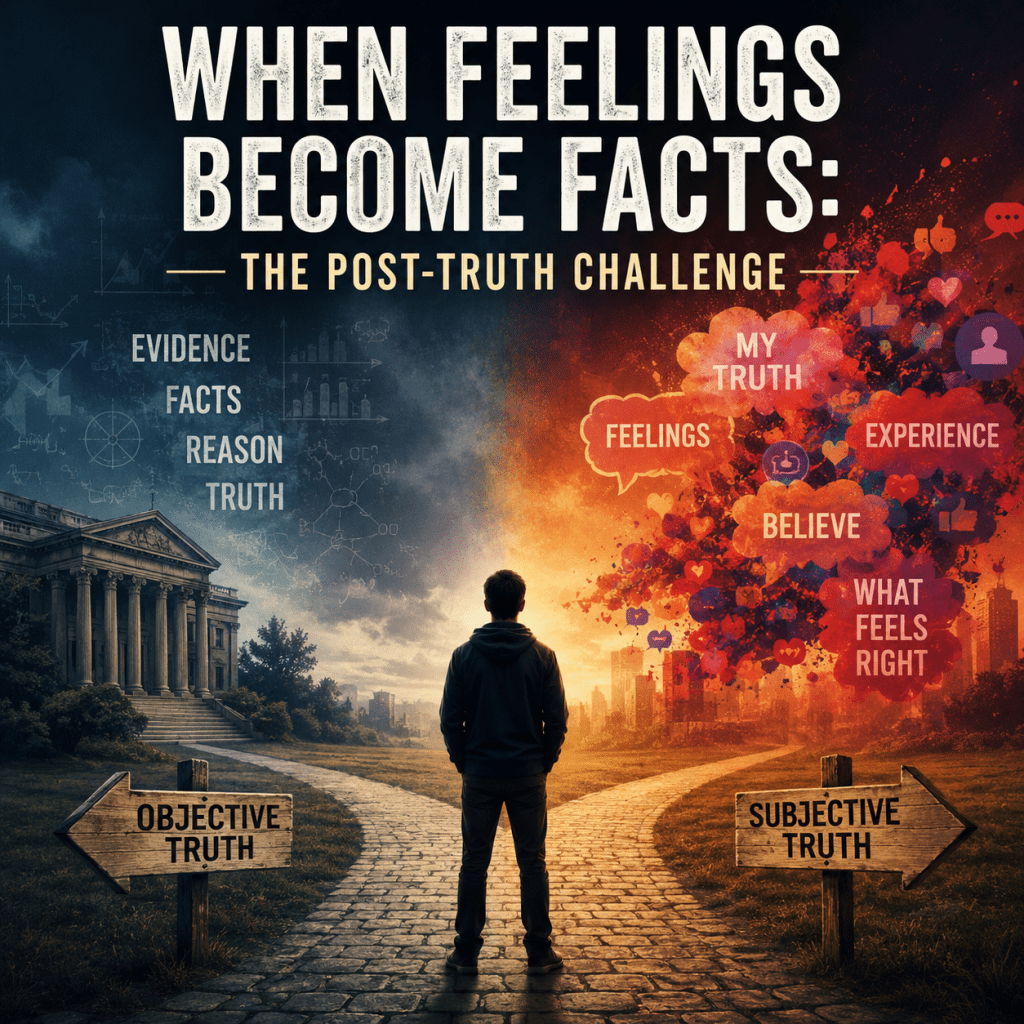
Over the past century, Western societies have increasingly expanded the authority granted to subjective experience in defining personal identity and public life. This development has brought new insights into human experience while also creating difficult questions about how subjective experience should relate to empirical evidence, shared institutions, and democratic decision-making.
This may describe one of the most significant cultural changes of the modern era. For most of Western history, truth was understood to exist outside ourselves. Whether grounded in God, nature, science, law, or long-established institutions, truth was assumed to be something that individuals discovered rather than created. Personal experience certainly mattered, but it was generally viewed as one source of knowledge among many. Experience could illuminate reality, but it did not define reality.
Over the last century, that balance has gradually shifted. Our culture has increasingly elevated subjective experience from being evidence about the world to becoming an authority over the world. The question has subtly changed from “What is true?” to “What is true for me?” This shift has produced genuine benefits. It has encouraged greater attention to mental health, increased awareness of trauma, and given voice to people whose experiences were too often dismissed or ignored. It has reminded us that statistics do not tell every human story and that empathy requires listening before judging. But every cultural gain comes with its own set of challenges.
When personal experience becomes the highest authority, disagreement becomes increasingly difficult. If my deepest feelings define reality, then questioning my conclusions can feel like questioning my identity. Debate no longer concerns competing interpretations of evidence; it becomes a conflict between competing personal realities. This helps explain why contemporary public discourse often feels so different from previous generations.
Political debates rarely stay focused on evidence for long. Scientific findings are frequently filtered through ideological commitments before they are evaluated. Social media algorithms reward emotional certainty over careful reasoning. Public conversations increasingly ask us not merely to disagree with one another but to choose which competing narratives we will inhabit. In this environment, facts often become secondary to identity. Psychologist Jonathan Haidt argues that “Intuitions come first, strategic reasoning second.” We often believe we are reasoning our way to conclusions when we are actually defending conclusions our emotions have already reached.
The modern phrase “my truth” captures this transformation perfectly. It usually does not mean “my perspective” or “my experience.” It often suggests that personal experience possesses its own independent authority regardless of whether it corresponds with external reality.
This is one reason the phrase “post-truth” has become so common. A post-truth society is not necessarily one in which facts disappear. Rather, it is one in which facts lose their ability to settle disagreements because different groups no longer recognize the same standards of authority. Hannah Arendt warned more than fifty years ago that “Freedom of opinion is a farce unless factual information is guaranteed.” Democracy depends on vigorous debate, but debate becomes impossible if citizens no longer share a common understanding of basic facts.
“Freedom of opinion is a farce unless factual information is guaranteed.”
— Hannah Arendt, Truth and Politics (1967)
History offers an interesting parallel. During the Modernist-Fundamentalist conflict of the early twentieth century, Christians fiercely debated the authority of Scripture, science, historical criticism, and religious experience. Both sides appealed to sources outside themselves—even when they disagreed profoundly about which sources deserved the greatest authority. The central question was, “What should count as authoritative?”
Today’s cultural conflicts often ask a different question altogether. Increasingly, authority itself is being relocated into the individual. Personal authenticity has become the highest moral value. To deny someone’s internal understanding of themselves is frequently seen not merely as disagreement but as harm. This development can be seen in debates over gender identity, politics, race, religion, and countless other issues. These debates are not simply disagreements about policy. They reflect competing understandings of where truth ultimately resides. Competing world views that are increasingly incompatible.
One worldview continues to believe that reality exists independently of us and that our responsibility is to discover and understand it as honestly as possible. The other increasingly argues that our internal experience plays a central role in defining who we are and how society should recognize us. Neither position is entirely wrong, but the conflict between them makes it ever more difficult to reconcile the two.
Objective facts without compassion can become cold and dehumanizing. Human beings are more than data points, and every statistic represents real lives with real experiences. Yet subjective experience without objective reference points creates its own dangers. If every deeply held conviction becomes equally authoritative, society loses the shared standards necessary for resolving disagreements peacefully. Democracy depends upon citizens who can disagree while still appealing to common evidence, common language, and common institutions. That may be the greatest challenge facing contemporary culture.
The real danger of the post-truth age is not that people tell more lies than previous generations. Human beings have always distorted the truth when it served their interests. The deeper danger is that we increasingly lack agreement about what counts as truth in the first place. Once that happens, every disagreement becomes a struggle for power rather than a search for understanding.
“Everyone is entitled to his own opinion, but not to his own facts.“
Daniel Patrick Moynihan
Perhaps recovering healthy public discourse does not require choosing between objective facts and subjective experience. We need both. Human experience often raises important questions that demand our attention. Empirical evidence helps us test our conclusions. Compassion reminds us why the discussion matters. Humility reminds us that none of us sees the whole picture.
Truth has always required both careful observation and honest self-examination. The challenge before our generation is not deciding whether feelings matter. They do. The challenge is remembering that feelings, however deeply felt, are not the same thing as facts. A healthy society requires both empathy for individual experience and a shared commitment to realities that exist beyond ourselves. Only then can disagreement become what it ought to be—not a battle between competing identities, but a common search for what is true.
Selected References for Further Reading
Foundational Works on Truth, Identity, and Modern Culture
Arendt, Hannah. Between Past and Future: Eight Exercises in Political Thought. New York: Viking Press, 1961. (See especially the essay “Truth and Politics,” added in the 1968 edition.)
Bellah, Robert N., Richard Madsen, William M. Sullivan, Ann Swidler, and Steven M. Tipton. Habits of the Heart: Individualism and Commitment in American Life. Berkeley: University of California Press, 1985.
Berger, Peter L., Brigitte Berger, and Hansfried Kellner. The Homeless Mind: Modernization and Consciousness. New York: Random House, 1973.
Cassam, Quassim. Vices of the Mind: From the Intellectual to the Political. Oxford: Oxford University Press, 2019.
Haidt, Jonathan. The Coddling of the American Mind: How Good Intentions and Bad Ideas Are Setting Up a Generation for Failure. New York: Penguin Press, 2018.
Haidt, Jonathan. The Righteous Mind: Why Good People Are Divided by Politics and Religion. New York: Pantheon Books, 2012.
Higgins, Kathleen. “Post-Truth: A Guide for the Perplexed.” Nature, Vol. 540 (2016): 9.
Keyes, Ralph. The Post-Truth Era: Dishonesty and Deception in Contemporary Life. New York: St. Martin’s Press, 2004.
Lasch, Christopher. The Culture of Narcissism: American Life in an Age of Diminishing Expectations. New York: W. W. Norton & Company, 1979.
Levin, Yuval. A Time to Build: From Family and Community to Congress and the Campus, How Recommitting to Our Institutions Can Revive the American Dream. New York: Basic Books, 2020.
MacIntyre, Alasdair. After Virtue: A Study in Moral Theory. 3rd ed. Notre Dame, IN: University of Notre Dame Press, 2007.
McIntyre, Lee. Post-Truth. Cambridge, MA: MIT Press, 2018.
Moynihan, Daniel Patrick. Daniel Patrick Moynihan: A Portrait in Letters of an American Visionary. Edited by Steven R. Weisman. New York: PublicAffairs, 2010. (Contains the frequently quoted statement, “Everyone is entitled to his own opinion, but not to his own facts.”)
Postman, Neil. Amusing Ourselves to Death: Public Discourse in the Age of Show Business. New York: Penguin Books, 1985.
Rieff, Philip. The Triumph of the Therapeutic: Uses of Faith after Freud. Chicago: University of Chicago Press, 1966.
Taylor, Charles. A Secular Age. Cambridge, MA: Harvard University Press, 2007.
Taylor, Charles. Sources of the Self: The Making of the Modern Identity. Cambridge, MA: Harvard University Press, 1989.
Trueman, Carl R. The Rise and Triumph of the Modern Self: Cultural Amnesia, Expressive Individualism, and the Road to Sexual Revolution. Wheaton, IL: Crossway, 2020.
Weaver, Richard M. Ideas Have Consequences. Chicago: University of Chicago Press, 1948.
Historical Background on American Religion and Culture
Marsden, George M. Fundamentalism and American Culture. 2nd ed. New York: Oxford University Press, 2006.
Noll, Mark A. The Scandal of the Evangelical Mind. Grand Rapids, MI: Eerdmans, 1994.
Smith, Christian. What Is a Person? Rethinking Humanity, Social Life, and the Moral Good from the Person Up. Chicago: University of Chicago Press, 2010.

