Medicare for All: The Hidden Truths Uncovered

I see more and more posts with people advocating Medicare for All or some other form of single payer healthcare system in the United States. It’s a grand idea, but it just won’t work. Let me explain why.
Let’s start with some core assumptions behind this debate.

  1. A single-payer system would make healthcare services available to all Americans on an equal basis with no “out of pocket” cost for services provided.
  2. A single-payer system would remove the need for private/commercial insurance coverage and the associated premiums and out of pocket costs.
  3. All medical services can and would be available through the single-payer system.
  4. Costs for a single-payer system could be covered by reducing current spending on other programs (i.e. defense) and/or by increasing taxes paid by high income/high net worth individuals.
  5. Systems similar to those in other developed countries could be used as a model for an effective system in the United States.
    Let’s consider the idea of Medicare for all. In this model, Medicare would be expanded to include every American. When people suggest this, I think most don’t understand how Medicare actually works.
    What is Medicare?: Medicare is the federal health insurance program primarily for people aged 65 and older, though it also covers younger individuals with certain disabilities or conditions like End-Stage Renal Disease. Medicare is divided into four parts:
    • Part A (Hospital Insurance): Covers inpatient hospital stays, skilled nursing facilities, hospice, and some home health care.
    • Part B (Medical Insurance): Covers outpatient care, doctors’ services, preventive services, and medical supplies.
    • Part C (Medicare Advantage): Private plans approved by Medicare that bundle Parts A and B, often with additional benefits (i.e. Dental, Vision, Fitness).
    • Part D (Prescription Drug Coverage): Helps cover the cost of medications.
    Because original medicare does not cover all costs and does not include prescription drug coverage, the system has approved additional coverage options to help.
    • Medicare Supplements (sometimes called Medigap) offer supplemental coverage that helps cover the cost of out of pocket expenses not covered my Part A and Part B.
    So, Medicare operates as a partnership between the government and private insurance companies. But let’s keep looking to see what else we need to know.

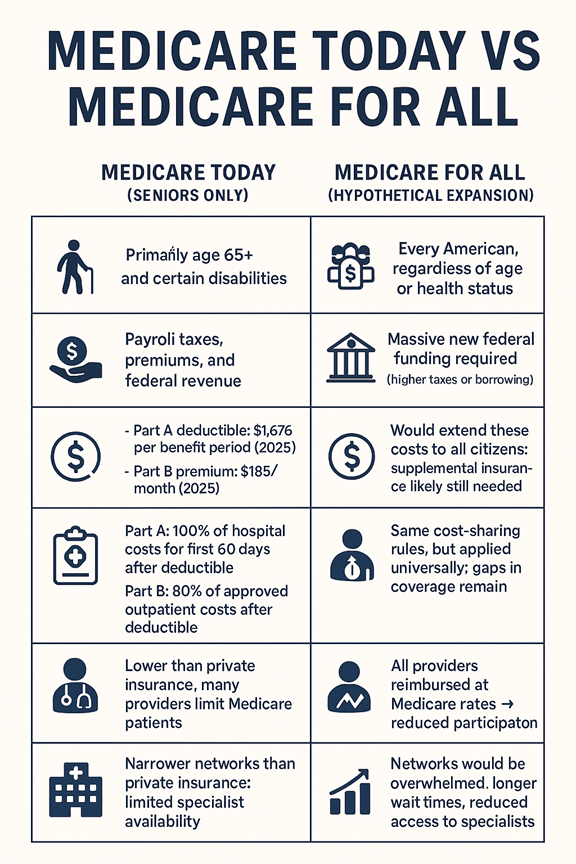
Medicare is not free; Medicare is often misunderstood as “free healthcare,” but in reality, it is a cost-sharing system between the government and beneficiaries. enrollees pay premiums, deductibles, and coinsurance, and the program itself is funded by payroll taxes, premiums, and general federal revenue. To understand why expanding it to all Americans would be so expensive, it’s important to look at how much Medicare actually pays versus what patients still owe.
The Cost of Medicare for Current Seniors
Medicare already represents a significant financial burden:
Medicare Part A (Hospital Insurance)
• Coverage: Inpatient hospital stays, skilled nursing facilities, hospice, and some home health care.
• Costs Covered:
o After you pay the deductible ($1,676 in 2025), Medicare Part A covers 100% of hospital costs for days 1–60 of a benefit period.
o For days 61–90, patients pay a daily coinsurance ($419 in 2025).
o Beyond 90 days, patients can use lifetime reserve days (up to 60 total), but coinsurance rises to $838 per day.
• Bottom Line: Medicare Part A covers the bulk of short-term hospital stays, but extended stays quickly shift costs back to patients.
Medicare Part B (Medical Insurance)
• Part B: The standard monthly premium in 2025 is $185 (going up to $205 in 2026), with a deductible of $257 ($283 for 2026). Higher-income seniors pay more (sometimes a lot more. Do a quick Google search for IIRMA and check it out).
• Coverage: Outpatient care, doctor visits, preventive services, lab tests, imaging, durable medical equipment, and mental health services.
• Costs Covered:
o After the annual deductible, Medicare Part B pays 80% of approved medical costs.
o Patients are responsible for the remaining 20% coinsurance, and some providers may charge up to 15% more (known as “excess charges”) if they accept Medicare but not full assignment.
• Bottom Line: Medicare Part B is a cost-sharing plan, not full coverage. Patients must budget for 20% of nearly all outpatient services.
• Oh, and Medicare Part B does not cover an annual physical with no cost sharing like ACA or employer sponsored plans do.
Medicare Part D
• Part D: Prescription drug coverage also comes with premiums and income-related surcharges. Deductibles can vary by plan but could be as high as $615.00 in 2026 while premiums are projected to average $35.00 with some people paying significantly more. And then, members must still pay the co-pays for their specific medications up to the annual out of pocket limit of $2,100.
These costs are substantial even for the current senior population. Expanding Medicare to cover all Americans would multiply these expenses dramatically, requiring either massive tax increases or unsustainable federal borrowing. In fact, it is quite possible that implanting this system would actually force most American households to pay more out of pocket (in the form of taxes) than they currently pay through premiums and out-of-pocket costs under their private insurance plans.
So, ok it would be expensive. And maybe we could find away to reduce costs or increase taxes enough to pay for it, but what happens when we add everyone in the country to this single system? How does the system absorb all of those new members?


The Strain on Provider Networks
Medicare’s provider networks are already limited compared to private insurance. Studies show that Medicare Advantage enrollees often have access to only about half of the physicians in their area compared to traditional Medicare. Narrow networks and reimbursement challenges mean that many providers are reluctant to accept Medicare patients.
If Medicare for All were implemented many researchers predict:
• Provider shortages would worsen. Doctors and hospitals already face reimbursement rates lower than private insurance, which could discourage participation.
• Rural hospitals in the US are already under financial strain. Forcing them to accept all patients with current Medicare reimbursement rates could force many of them into bankruptcy. At the very least it would force providers to ration their time and create long waiting lists for non-urgent services.
• Wait times would increase. With tens of millions of new patients entering the system, the demand for services would far outpace supply.
• Quality of care could decline. Overburdened networks would struggle to maintain standards, especially for complex or specialized care.


Conclusion
Medicare for All may sound appealing as a universal solution, but the reality is stark:
• Medicare is already expensive for seniors and taxpayers.
• Expanding it nationwide would require enormous new funding.
• Provider networks would be overwhelmed, leading to longer waits and reduced access.
• We haven’t even considered the disruption that would be caused by the loss of 600,000 to 900,000 jobs in the private health insurance industry. None of the models account for that disruption.
For these reasons and more, I believe Medicare for All is not a practical or sustainable path for the U.S. healthcare system. Instead, reforms should focus on improving affordability and access without dismantling the balance between public and private coverage.

The Limits of Diversity and Tolerance

I have always thought of myself as a tolerant person and someone who values diversity. I still think of myself that way, but more and more I am seeing the limits of those concepts in our culture. Maybe you have seen it too. It leads me to ask a question: What are the limits of diversity and tolerance?

There is incredible pressure in American culture today to be “inclusive” and tolerant. I don’t think anyone would disagree with that. And, I think there is much good in the diversity we are working to embrace. At the same time, there is a growing sense of discomfort among many in the culture who do not feel “accepted.” What is interesting to me today is how many of those people come from majority population segments. Here’s the crux of the matter. Diversity and tolerance today press upon us the need to recognize, understand, support, accept and embrace minority cultures. It emphasizes the importance of “seeing” and “embracing” the cultures of people of color, LGBTQ+ cultures, minority religious cultures and other minority identities. In so far as we can embrace that kind of diversity and demonstrate acceptance of those peoples and those cultures, we are ourselves accepted. But what happens if someone or some group of people find those cultural expressions unacceptable?

If I wrote today that I cannot “accept” the efforts of the transgender community to promote and extend the “rights” of biological males to participate in sporting activities with biological females and that I would vote against the extension of such “rights,” would that make me intolerant? I suppose it would, but what if I wrote that I believe on the premise of “critical race theory” that white Americans are infected by systemic racism and their access to power and influence should be specifically limited. Am I not also now intolerant?

These are just some things I have been thinking about that I want to explore further. Here is the central idea, and I would like to have some discussion around it. I believe that the very heart of culture, all culture, is the values you hold so dear that you are unwilling to yield those values. In other words, culture is completely centered in the non-negotiable values you hold as your own. I believe that everyone one of us has those values and that when we encounter threats to those values we express our “intolerance” in whatever ways we believe are necessary to protect and defend our culture. I also believe that the modern appeals to tolerance and diversity neglect or even perhaps ignore the values of other cultures and are attempting an overthrow of culture that is neither diverse nor tolerant. On the contrary, modern movements for tolerance and diversity seem to be intentionally intolerant of any culture or group that does not specifically adopt, promote and accept their views of culture.

I have no doubt there are many people who will disagree with this, but I’m curious so see what you think. Let’s talk

Shalom,

Kevin

Tired of Being Misled!

“False testimony my be refuted, but once it is voiced, everyone repeats it” Proverbs 21:28 as translated by Rabbi Rami M. Shappiro

Ok, so have you visited social media any time recently? Or how about have you watch the news on TV or cable? Have you read the newspaper? If the answer is yes, then you may agree with me that it seems like there is no way to know what is true any more. Raise your hand if you agree.

I may just be speaking for myself, here, but I am really tired of reading posts or watching stories that are filled with “spin.” It seems like every person’s goal is simply to prove their own point of view without consideration for what is actually true or right or good or valuable. There are so many examples of this that it is hard to decide which ones to use. Here is one.

On a recent newscast a reporter declared that President Trump had contradicted his own leading scientists regarding the expected availability of a vaccine for the corona virus. They went on to play a recorded clip from the President followed by one from the head of the CDC as proof of the contradiction. They also threw in a clip from Dr. Fauchi to further support their contention. On the surface, it appeared their complaint was valid. But wait a minute…

A simple review of the larger context of the statements by all three people reveals that maybe the story is not quite so simple. It turns out that the President was talking about how quickly a vaccine might be available to distribute to a broad segment of the population that are most at risk from the virus while the CDC Director was talking about how quickly the vaccine would be available for the “majority” of Americans. Those are actually two very different things. And, to top it all off, it turns out Dr. Fauchi agreed with both the President and the CDC Director.

What bothers me the most here is not whether or when a vaccine will be available. What bothers me is the apparent effort by the media to twist the facts of the story (because after all, these are all facts) in order to promote a narrative that attempts to discredit the President. I know they don’t like him. I know they don’t agree with him. I know they would like to see him voted out of office. But this is a form of deception that is insidious and dangerous. It threatens our culture because it diminishes the trustworthiness of the free press.

What makes it worse, in my view, is the way so many Americans are quick to pick up on such a story and spread it immediately and without criticism across social media. In a world where fewer and fewer people actually watch the news or read the papers, social media has become the source of much of what we know about our world. It is a powerful tool for both good and evil and it is being used for both purposes. When people uncritically repeat so called “facts” in social media they often unwittingly spread falsehoods. And the industry “fact checkers” are no help at all. Their purported objectivity is so obviously biased that it is laughable to call it anything but censorship and propaganda.

Once a story like this hits the media, whether broadcast or social, it seems unstoppable. Solomon saw the problem thousands of years ago. A false story, once started, even if it is proved false, will continue to spread. And why is that? It is because people continue to repeat it without discrimination. If it fits their preconceived ideas then it is repeated and promoted without hesitation. And of course, if you challenge someone who posts this information, you are likely to be attacked, called a fool, ridiculed, and/or dismissed.

Don’t be fooled. As we move quickly toward what could be the most important national election in a century or more, I want to urge people to be discerning. Ask more questions. Be slow to accept and even slower to respond. Look past the spin no matter where it comes from and treat every story with a healthy dose of skepticism. Don’t think that you already know – remember what Solomon wrote, “Know-It-Alls display their ignorance.” Don’t be an know-it-all and don’t spread false reports.

Shalom,

Kevin

I Have Been Foolish – No More!

“Fools do not want to understand anything. They only want to tell others what they think.” Proverbs 18:2 NCV

Love, Companionship, Friendship

Social media has become a dangerous place to hang out. What used to be a great way to keep in touch with friends and family and to have the occasional conversation about history or politics has become a place where people feel free to attack others without fear of repercussions. Civil discussion has devolved into angry rants punctuated by links to media sources cited as “proof” of the rectitude of each person’s ideas.

Writing in the book of Proverbs, Solomon seems to have seen some of this coming and warned us against it. He wrote that “fools” don’t participate in a conversation in order to understand and grow. All they really want is to tell others what they think. This is so prevalent in social media communication that I’m afraid it is becoming the norm. And along with it people have allowed hate, rage, and disrespect to become their norms in communication. People are so quick to place a label of hate on others. They are so impatient to prove that they are right and the others are wrong. They are absolutely determined to “prove” their position not by reasoned debate built on understanding but rather by beating the other person into submission with a barrage of angry words and hateful accusations. Everyone is either a socialist or a fascist. They are idiots or morons because they disagree with you.

In a culture at the crossroads, I fear these are signs that we are closer each day to a catastrophic break that will issue in disaster. We can already see the signs in the violence in so many places across the nation. Portland, Kenosha, Chicago, New York, Los Angeles . . . the list goes on. Protest has become riot. Riot has become open conflict with armed combatants on all sides. Deaths are on the rise and there does not appear to be any end in sight.

Political figures on both sides of the growing divide seem unwilling and unable to provide leadership. There is no vision for peace coming from any of them. The President and Republicans want to blame the Democrat leadership of the states and cities and make it their problem. The Democrats want to blame the President and Republicans, calling them out for being divisive and failing to provide unity. I believe they are all correct and all absolutely in the wrong. For none of them are willing to stand up and lead. None of them are willing to provide a vision for all Americans to follow a path toward peace. Each of them seems so focused on keeping themselves in power that they have no idea how to lead us to cultural unity and compromise.

In the absence of leadership from our elected officials, it is time for we, the people, to stand up on our own and assume the mantle of leadership. I’m not talking about political action or even public protest. I am talking about leading through influence with one another. We don’t need a politician to tell us how to behave. We already know. We need to work together to build a new consensus in our culture. We don’t have to agree, but we do need to respect, listen to and learn from one another. We need each other to be whole.

In the past six months I have been called a racist, a white supremacist, a homophobe, a narcissist, a bully, an old white man, a fool, and “boomer.” I have been labeled a “Trumper” and tagged a Fox News groupie and an NRA tool. I guess I am an old white man, LOL. At least as some people count old. But the rest of these labels just don’t fit and I reject them without any hesitation. Even more, I reject the very idea that labeling others with terms intended to demean, diminish and defeat them and their ideas is a proper way to discuss what divides us. As long as people continue to follow this path the divisions will grow and the hatred that drives those divisions will increase.

I confess, I have been guilty in the past of contributing to the anger on social media. I have written hurtful things and failed to see the person behind the post. I made a commitment to myself several months ago to cease this practice. I am doing my best to focus every time on hearing the person on the other side of my comments and taking their perspective into consideration. I am committed to doing everything possible to keep my contributions focused on not just facts, but truth. Facts can be used in countless ways to support a position, but truth takes into account how facts intersect with other facts and how perspective and preconception influence each position.

I don’t know who will read this or who will agree to it, but I hope and pray that many will choose to follow my example in this and heed my plea. Join me in a new movement in America to focus on peace and unity instead of conflict and division. Who will join me?

Shalom

Kevin

Is Our Culture Headed for War?

The stage is set for what could be the most important national election since 1860. Not since that momentous election have we been so divided as a people. Or at least is seems so to me. Our divisions touch deep into our culture and expose not just a divide or politics and policy, but an even deeper divide over core values. That, I believe, is at the heart of the choice we must make.

To understand the choice, we need to first understand at least a little bit about culture. When I use that word here, I mean to focus on the shared ideas and values that together form our common understanding of how things “should” be. In particular, I’m thinking of the values we hold as people that we believe are important enough to argue, debate, and even fight over. Those values that are important enough to organize our lives around. In other words, what matters enough for you to fight about and how far are you willing to go in that fight to translate your values into practice and policy for your community, your state, your nation.1

At every level there can be and often are competing value systems that inform culture. In a nation as large and diverse as the United States there are always competing values. We see them at every level. My values don’t always match those of my family members. My neighbors and I may disagree on a variety of issues. People in my community, my state, my region, and my nation all have values that we share and some on which we disagree. In most times and most circumstances those differences make for interesting and often spirited debate.

Culture is not simply ideas, and debate over culture is not the same as debate or discussion about ideas. Culture is made evident in living and its values are translated into policies, practices, actions and relationships. Culture is not just what we think or believe, it is how we choose to live because of what we think or believe. And because culture truly matters we extend our choices about the right way to live to others around us. We say, in effect, what I think or believe is right, and I think others should agree with me and so live as I choose to live.

When these choices are localized and personal and when they are considered part of our individual liberty, they have little power to divide. For example, I believe going to Church on Sunday morning is important and valuable and I choose to make that a priority for my family. If my neighbor disagrees and chooses instead to spend Sunday morning resting at home that may make for an interesting discussion between us, but its not likely to cause us to fight. What would happen, though, if I came to believe that going to Church is so important that every American should be mandated appear in church on Sunday morning and I attempted to pass that value into law? Would you fight me?

Of course you would. And you would fight using every intellectual, social and political tool available to you to make sure that my values were not forced on you. Forcing someone to go to church violates the 1st Amendment, you would argue. You can’t force someone to believe, you might say. That idea violates my personal rights! If you and I cannot reach some form of comprise, and if we each hold to our value strongly enough that we are willing to fight for it, we are divided. At this point in the debate one of us must win and the other must lose.

This happens all the time in society and politics. The clash of values plays itself out in elections, in legislative activity, in courts of law, and in a thousand other regular interactions among people everywhere. It hurts to be on the losing side in an election and we don’t like to follow policies we don’t agree with, but we do because we hold a greater set of values more dear. For a majority of Americans, the core values expressed in the Pledge of Allegiance, “one nation, under God, indivisible with liberty and justice for all,” have prevailed. Those “higher” values along with a common commitment to civil discourse, freedom of expression and good will toward others has meant we can agree to disagree and accept both our wins and our losses with grace.

So what happens when some one or some group of people cannot accept these differences in culture with grace? What happens when you lose the battle over and election, or a policy, or a law and you can’t or won’t accept the outcome? Historically this can be the impetus that creates a new social or political movement. It has been the seed bed for the birth of new political parties and new social alliances of many forms. Often, the result is civil unrest in some form. Peaceful protest and non violent civil disobedience are not uncommon. Violent civil disruptions may also seem like the right action for some. Only in very rare circumstances does the dispute reach the level of open division and conflict between two clearly identified value systems that cannot seem to coexist. The highest and most devastating form of culture conflict is civil war. That is what happened in 1860.2

Could it be happening again? I can’t say it is certainly so, but something is happening in America today that I believe threatens the unity of our nation and I think its root cause is a widening divide in cultural values. Its not just the difference between Democrats and Republicans. It goes much deeper. Every element of culture seems to be in conflict to a greater or lesser degree. The differences are substantial and it is increasingly difficult to envision policy outcomes that will satisfy all sides of the growing divide. voices on the left have already taken to the streets in both peaceful and violent protest. Voices on the right are calling for open and armed resistance should the left win out and enact policies that violate their core values. Voices of compromise and restraint seem to be dwindling in both numbers and volume. It is a scary and challenging time for Americans.

Is there anything we can do about? I think there is. I think the first thing to do is to get involved and stay involved in the conversation about values. It will be uncomfortable. (I was going to say it might be uncomfortable but I think it is more certain than that) I intend to stay involved myself and to forward my contributions through this blog and the other forms of modern communication available to me. I welcome anyone who wants to explore the values of culture today and influence their adoption in America to join me in the discussion.

1Defining Culture is complex. Understanding the elements of culture even more so. There is a vast literature on culture, its definition, its meaning, its expression and its impact. A good starting point for someone who just wants to join the conversation might be the wikipedia article on culture. Find it here. https://bit.ly/3g29pCd If you want to dig deeper into the topic you might want to start with this list of books here https://bit.ly/2DVinnQ.

2A good starting point for understanding how the division of culture produced the Civil War in America is “Cultures in Conflict: The American Civil War” by Steven E. Woodworth. Greenwood Press, 2000.

Does God Belong to a Political Party?

I made a mistake yesterday. It’s not the first time I have made this mistake, and it’s probably not the last time either. I got involved in a political discussion on Facebook! I know, right? What was I thinking? But then again, sometimes I come across something so troubling that I just can’t stay silent.

Yesterday’s foray into the futile began when I came across a post from a “friend” who was explaining why he could never vote for a Democrat. He said a lot of mean things about Democrats and insisted that because of his faith in Jesus he could never support a Democrat for political office. Although I didn’t agree with him, I also didn’t really find anything in his post that surprised me and I wasn’t going to even respond. Then I did it, I began to read the comments. (Now really, I should know better, right?)

As you can imagine, his post sparked some spirited response. But about halfway down the list I came across a post from another reader and that’s the one that got me hooked. You see, this contributor not only passionately disagreed with the original post, she went a big step further. She wrote “I firmly believe you cannot be a Christian and vote Republican.” And then she went on to list a litany of supposed Republican sins that reflect the political climate of today translated into violations of God’s law and proof that all Republicans are going to hell. After completing her list of supposed Christian political and economic values she concluded with, “I call bullshit on any Christian who does not support a party that is willing to provide these basics of life.”

I read through her list of issues and I found myself agreeing with her on some and disagreeing on others. But no matter how much we might agree on some issues, I was moved to challenge her post on this issue. How can a person fairly conclude that being a political party member or voting for a candidate disqualifies you from being a Christian? That seems to me a bit too far to go. And so I challenged her.

I didn’t challenge her politics, at least not directly. I challenged her view of grace. I asked if the God who promised grace to all through Jesus Christ would not offer just as much grace to a Republican as he would to a Democrat. I asked how it is that we, who are all sinners, can come to the place where we not only disagree on politics but then tie those disagreements to someone’s faith. I honestly wanted to know. She honestly wanted to tell me why I could not possibly be a Christian.

I don’t support universal health care. I don’t support abortion on demand. I don’t support the “wealth tax” that has become so popular these days. I don’t support free college education. These are the things that “prove” to her that I cannot possibly be a Christian.

Let that sink in a minute. Then, I would love to hear how you would respond. I’ll be happy to tell you what I said later. For now, I hope this sparks a little conversation. Here are some questions:

  1. Does God have a political party?
  2. Does your position on an issue of political, economic or social importance determine your status as a Christian?
  3. How does God’s grace apply to our differences of opinion on the big social/political/economic issues of our times?

I hope to hear from some of you on this one.

Shalom,

Kevin

The Times They are Certainly Changing

When Bob Dylan released his classic song “The Times They are A Changin” in 1964, we was witnessing a dramatic shift in American culture. The civil rights movement was in full swing and it seemed to many that America was being remade. For some it was a sign that the nation was growing up and fulfilling its destiny. To others it appeared the nation was coming apart at the seams and on the verge of collapse. For everyone in America it was a time of tremendous turmoil and rapid change.

Looking at America today it seems we are at that place again, and Bob Dylan’s words are just as relevant now as they were then. If you haven’t listended to his original lyrics in a while this might be a great time to check it out. Here’s a link https://youtu.be/90WD_ats6ez

As a student of history I can’t help but see the parallels. Our nation, our states, our cities, our neighborhoods are in turmoil as we wrestle with big questions about our social structures, our values, our ideas, our cultural core. It is hard to imagine where this will lead and what America will look like when this wave of change has run its course. One thing I believe, though, it is critical that we talk about it.

That’s why I started this blog. I wanted a place to write about what I am seeing and talk about what I believe are really important issues facing our culture. I wanted a place to have an open conversation about big subjects with other people who care as I do about all this works out. So, here I am.

This blog will be an open discussion. I want to encourage as many people as are willing to join in the discussion, but I hope and pray we can avoid the kind of uncivil discourse that seems to plague the social media pages. I confess, I have been a contributor to that at times and my own anger has had the best of me. If someone reading this has been on the receiving end of one of my less civil posts, please accept my apology. At the same time, I believe the changes in our cuture are deserving of a passionate response and I intent to offer my ideas passionately and honestly. I encourage others to do the same.

Shalom,

Kevin